Saturday, 19 July 2025

MIXED PAPER (J)


EQUATION, INEQUATION AND EXPRESSION 


1) If x is a Real number such that x(x²+1), (-1/2)x², 6 are three consecutive terms of an AP then the next two consecutive terms of AP are
a) 14, 6 b) -2,-10  c) 14, 22 d) none 

2) The number of real solutions of x - 1/(x²-4) = 2 - 1/(x²-4) is 
a) 0 b) 1 c) 2  d) infinite 

3) The number of values of a for which (a²- 3a+ 2)x²+ (a²- 5a +6)x + a² -4=0 is an identity in x is
a) 0 b) 2 c) 1 d) 3 

4) The number of values of the pair (a,b) for which a(x +1)²+ b(x²- 3x -2)+ x +1=0 is an identity in x is 
a) 0 b) 1 c) 2  d) infinite

5) The number of values of the triple (a,b,c) for which
a cos 2x + b sin²x + c =0 is satisfied by all real x is 
a) 0 b) 2 c) 3  d) infibite

6) The polynomial (ax²+ bx+ c)(ax²- dx- c), ac ≠ 0, has
a) four real zeros b) at least 2 real zeros  c) atmost two real zero d) no real zeros 

7) Let f(x)= ax³+ 5x²- bx +1. If f(x) when divided by 2x + 1 leaves 5 as remainder, and f'(x) is divisible by 3x -1 then
a) a= 26, b=10
b)  a= 24, b=12
c) a= 26, b=12 d) none 

8) ₓ3ⁿ₊ ᵧ3ⁿ is divisible by x+ y  if
a) n is any integer ≥ 0
b) n is an odd positive integer
c) n is an even positive integer
d) n is a rational number 

9) If x,y are rational numbers such that
x+ y + (x -2y)√2= 2x - y + (x - y -1)√6 then 
a) x and y cannot be determined 
b) x=2, y=1 c) x=5, y=1 d) none 

10) The number of real solutions of the equation 
2ˣ⁾² + (√2 +1)ˣ = (5+ 2√2)ˣ⁾² is 
a) one b) two c) four d) infinite 

11) The number of real solutions of the equation eˣ= x is 
a) 1 b) 2 c) 0 d) none 

12) The sum of the real roots of the equation x²+ |x| - 6=0 is
a) 4 b) 0 c) -1 d) none

13) The solution of the equation 2x - 2[x] = 1, where [x]= the greatest integer less than or equal to x, are
a) x= n + 1/2, n ∈ N
b)  x= n - 1/2, n ∈ N
c) x= n + 1/2, n ∈ Z
d) x= n + 1, n ∈ Z

14) The number of real solutions of the equation  sin(eˣ)= 5ˣ + 5⁻ˣ is 
a) 0 b) 1 c) 2  d) infinitily many 

15) The number of real solutions 1+ |eˣ -1|= eˣ(eˣ -2) is 
a) 0 b) 1 c) 2 d) 4 

16) The equation 2 sin²(x/2) cos²x = x + 1/x, 0< x ≤π/2 has
a) one real solution 
b) no real solution 
c) infinity any real solutions d) none 

17) If y≠ 0 then the number of values of the pair (x,y) such that 
x + y + x/y = 1/2 and (x + y)x/y = -1/2, is
a) 1 b) 2 c) 0 d) none 

18) The number of real solutions of the equation log₀.₅x = |x| is 
a) 1 b) 2 c) 0 d) none 

19) The equation √(x +1) - √(x -1)= √(4x -1) has
a) no solution  b) one solution c) two solution  d) more than two solutions

20) The number of solutions of the equation |x|= cosx is
a) one b) two c) three d) zero 

21) The product of all solutions of the equation (x -2)² - 3|x -2|+ 2= 0 is
a) 2 b) -4 c) 0  d) none 

22) If 0< x <1000 and [x/2] + [x/3] + [x/5]= 31x/30, where [x] is the greatest integer less than or equal to x, the number of possible values of x is 
a) 34  b) 32  c) 33  d) none 

23) The solution set of (x)²+ (x +1)⅖= 25, where (x) is the least integer greater than or equal to x, is
a) (2,4) b) (-5,-4) U (2,3] c) [-4,-3)U [3, 4) d) none 

24) If èˣ⁺¹ = 6ˡᵒᵍ₂3 then x is 
a) 3 b) 2 c) log₃2 d) log₂3

25) If (√2)ˣ + (√3)ˣ= (√13)ˣ⁾² then the number of values of x is 
a) 2 b) 4 c) 1 d) none 

26) The number of real solutions of the equation (6- x)/(x²-4) = 2+ x/(x +2) is 
a) two b) one c) zero d) none 

27) The number of real solutions of 
√(x²- 4x +3) + √(x²-9)= √(4x²- 14x +6) is 
a) one b) two c) three d) none 

28) If [x]= the greatest integer less than or equals to x, and (x)= the least integer greater than or equal to x, and [x]²+ (x)²> 25 then x belongs to
a) [3,4] b) (-∞,-4] c) [4, ∞) d) (-∞, -4] U [4,  ∞)

29) Let R= the set of real numbers , Z= the set of integers , N= the set of natural numbers. If S be the solution set of the equation (x)²+ [x]²= (x -1)⅖+ [x +1]², where (x)=  the least integer greater than or equal to x and [x]= the greatest integer less than or equal to x, then 
a) S= R b) S= R - Z c) S= R - N d) none 

30) If [x]²= [x +2], where [x]= the greatest integer less than or equal to x, then x must be such that 
a) x=2,-1 b) x ∈ [2,3) c) x ∈ [-1,0) d) none 

31) The solution set of |(x +1)/x| + |x +1|= (x +1)²/|x| is 
a) {x : x ≥ 0} 
b) {x : x > 0} U {-1}
c) {-1,1}
d) {x: x ≥ 1 or x ≤ -1}

32) The number of solutions of |[x] - 2x |= 4, where [x] is the greatest integer ≤ x, is 
a) 2 b) 4 c) 1 d) infinite 

33) The set of real values of x satisfying |x -1|≤ 3 and |x -1|≥ 1 is
a) [2,4] b) (-∞,2] U [4, + ∞) c) [-2,0] U [2, 4] d) none 

34) the set of real values of satisfying  | | x -1| -1|≤ 1 is
a) [-1,3] b) [0,2] c) [-1,1] d) none

35) If x y Z (the set of integers) such that x²- 3x < 4 then the number of possible values of x is
a) 3 b) 4 c) 6 d) none

36) If x is an integer satisfying x²- 6x + 5≤ 0 and x²- 2x > 0 then the number of possible values of x is
a) 3 b) 4 c) 2 d) infinite 

37) The solution set of the equation log₁/₃ (x²+ x +1)+ 1 > 0 is
a) (-∞,-2) U (1, +∞)  b) [-1,2]  c) (-2,1) d) (-∞, +∞)

38) 5ˣ + (2√3)²ˣ ≥ 13ˣ then the solution set for x is 
a) [2, +∞) b) {2} c) (-∞,2] d) {0,2]

39) If 3ˣ⁾² + 2ˣ > 25 then the solution set is
a) R b) (2, +∞) c) (4, +∞) d) none 

40) If sinˣα + cosˣα ≥ 1, 0 < α< π/2, then 
a) x ∈ [2,+∞) b) x ∈ (-∞,2] c) x ∈ [-1,1] d) none

41) The solutions set of x²+ 2 ≤ 3x ≤ 2x²- 5 is
a) φ b) [1,2] c) (-∞,-1] U [5/2, +∞) d) none 

42) The solution set of (x²- 3x +4)/(x +1) > 1, x ∈ R, is 
a) (3, +∞) b) (-1,1) U (3, +∞) c) [-1,1] U [3, +∞) d) none 

43) The number of integral solutions of (x +2)/(x²+1) > 1/2 is
a) 4 b) 5 c) 3 d) none 

44) If a, b,c are non-zero , unequal rational numbers then the roots of the equation abc²x² + (3a²+ b²)cx - 6a²- ab + 2b²= 0 are
a)  rational  b) imaginary c) irrational d) none 

45) If l, m are real and l ≠ m then the roots of the equation 
(l - m)x² - 5(l + m)x -2(l - m)= 0 are
a) real and equal 
b) non real Complex 
c) real and unequal d) none 

46) If a, b, c, d are four consecutive terms of an increasing AP then the roots of the equation (x - a)(x - c) + 2(x - b)(x - d)=0 are
a)  real and distinct  b) nonreal Complex  c) real and equal  d) integers 

47) If a,b,c are three distinct positive real numbers then the number of real roots of ax²+ 2b |x| - c =0 is
a) 4 b) 2 c) 0  d) none 

48) The equation x²- 6x + 8 + λ(x²- 4x +3)= 0, λ ∈ R, has
a) real and unequal roots for all λ
b) real roots for λ< 0 only 
c) real roots for λ > 0 only 
d) real and unequal roots for λ = 0 only 

49) If cosθ, sinφ,  sinθ are in GP then roots of x²+ 2 cotφ. x +1=0 are always 
a) equal b) real c) imaginary d) greater than 1

50) The roots of ax²+ bx + c=0, where a≠ 0 and co-efficients are real, are nonreal Complex and a+ c < b. Then 
a) 4a + c >2b b) 4a + c < 2b c) 4a+ c =2b d) none 

51) The equation (a +2)x²+ (a -3)x = 2a -1, a≠ -2 has roots rational for 
a) all Rational values of a except a= -2
b) all real values of a except a= -2
c) rational values of a> 1/2 d) none 

52) If a. 3ᵗᵃⁿˣ + a. 3⁻ᵗᵃⁿˣ -2= 0 has real solutions, x ≠ π/2, 0≤ x <π, then the set of possible values of the parameter a is
a) [-1,1] b) [-1,0] c) (0,1] d) (0,+∞)

53) If a> 1, roots of the equation (1- a)x²+ 3ax -1= 0 are 
a) one positive root and one negative root
b) both negative 
c) both roots positive 
d) both nonreal Complex 

54) If a∈R, b ∈ R then the equation x²- abx - a²= 0 has
a) one positive root and one negative root
b) both roots positive 
c) both root negative 
d) non-real roots 

55) If the roots of the equation x²- 2ax + a²+ a -3=0 are less than 3 then 
a) a< 2 b) 2≤a≤ 3 b) 3< a ≤4 d) a> 4

56) if α, β are the roots of x²- 3x + a =0, a∈ R and α < 1< β then
a) a ∈ (-∞,2) b) a ∈ (-∞, 9/4] c) a ∈ (2, 9/4] d) none 

57) If α, β be the roots of 4x² - 16x + λ= 0,   λ∈ R such that 1< α< 2 and 2< β< 3 then the number of integral solution of λ is
a) 5 b) 6 c) 2 d) 3

58) The number of integral values of a for which x¹- (a -1)x +3=0 has both roots positive and x²+ 3x + 6 - a =0 has both roots negative is
a) 0 b) 1 c) 2 d) infinite 

59) If X denotes the set of real numbers p for which the equation x²= p(x + p) has its greater than p then X is equal to 
a) (-2,-1/2) b) (-1/2,1/4) c) null set d) (-5,0)

60) If cos⁴x + sin²x - p =0, p ∈ R has real solutions then
a) p≤1 b) 3/4≤ p ≤ 1 c) p≥ 3/4 d) none 

61) If one root of the equation (k²+1)x²+ 13x + 4k=0 is reciprocal of the other than k has the value 
a) -2+√3 b) 2-√3 c) 1 d) none 

62) If the ratio of the roots of λx²+ μx + v =0 is equal to the ratio of the roots of x²+ x +1=0 then , λ, μ, v are in 
a) AP b) GP c) HP d) none 

63) p,q,r and s are integers. If the AM of the roots of x²- px + q²=0 and GM of the roots of x²- rx + s²=0 are equal then 
a) q is an odd integer 
b) r is an even integer
c) p is an even integer
d) s is an odd integer 

64) If α, β are roots of the equation (x - a)(x - b)= c, c≠ 0, then the roots of the equation (x - α)(x - β)+ c =0 are
a) a,c b) b,c c) a,b d) a+ c, b+ c

65) If the roots of 4x²+ 5k = (5k +1)x differ by unity then the negative value of k is 
a) -3 b) -1/5 c) -3/5 d) none 

66) The harmonic mean of the the roots of the equation 
(5+ √2)x² - (4+ √5)x + 8 + 2√5= 0 is
a) 2 b) 4 c) 6 d) 8

67) If the product of the roots of the equation x²- 5x + ₄log₂λ= 0 is 8 then λ is 
a) ±2√2 b) 2√2 c) 4 d) none 

68) If the roots of a₁x²+ b₁x + c₁ = 0 are α₁, β₁ and those of a₂x² + b₂x + c₂ =0 are α₂β₂ such that α₁α₂ =  β₁β₂ = 1 then 
a) a₁/a₂ = b₁/b₂ = c₁c₂ 
b) a₁/c ₂ = b₁/b₂ = c₁a₂ 
c) a₁a₂ = b₁/b₂ = c₁c₂  d) none

69) If α, β are the roots of ax²+ c = bx then the equation (a + cy)²= b²y in y has the roots 
a) α⁻¹, β⁻¹  b)  α², β² c)  αβ⁻¹,  α⁻¹β d) α⁻², β⁻²

70) If the roots of ax²- bx - c=0 change by the same quantity then the expression in a, b, c that does not change is
a) (b²- 4ac)/a²
b) (b - 4c)/a
c) (b² + 4ac)/a² d) none 

71) If α, β are the roots of x²- px + q=0 then the product of the roots of the quadratic equation whose roots are α²- β² and α³- β³ is 
a) p(p²- q)²            b) p(p²- q)(p²- 4q)
c) p(p²- 4q)(p²+ q)  d) none 

72) If the sum of the roots of the quadratic equation ax²+ bx + c=0 is equal to the sum of the squares of their reciprocals than b²/ac + bc/a² is equal to
a) 2 b) -2 c) 1 d) -1

73) If the absolute value of the difference of roots of the equation x²+ px +1=0 exceeds √(3p) then
a) p<-1 or p> 4 b) p> 4 c) -1< p< 4 d) 0≤ p < 4

74) If α, β are roots of x²+ px + q=0 and γ, δ are the roots of x²+ px - r=0 then (α - γ)(α - δ) is equal to
a) q+ r b) q- r c) -(q+ r) d) -(p + q+ r)

75) If α, β roots of 375x²- 25x - 2=0 and sₙ = αⁿ + βⁿ then limₙ₋∞ ⁿᵣ₌₁∑ sᵣ is 
a) 7/116 b) 1/12 c) 29/358 d) none 

76) The quadratic equation whose roots are the AM and HM of the roots of the equation x²+ 7x -1= 0 is
a) 14x²+ 14x - 45= 0
b) 45x²- 14x + 14=0
c) 14x²+ 45x - 14=0 d) none 

77) Let α ≠ β and α²+ 3 = 5α while β²=  5β -3. The quadratic equation whose roots are α/β and β/α is 
a) 3x²- 31x +3=0
b) 3x²- 19x +3=0
c) 3x²+ 19x +3=0 d) none

78) If a, b are rational and b is not perfect square then the quadratic equation with rational co-efficients whose one root is 1/(a + √b) is 
a) x²- 2ax + (a²- b)= 0
b) (a²- b)x²- 2ax +1=0
c) (a²- b)x²- 2bx +1=0 d) none

79) If 1/(4- 3i) is a roots of ax²+ bx +1=0, where a,b are real, then 
a) a= 25, b= -8 b) a=25, b=8 c) a=5, b=4 d) none 

80) If α, β be the roots of the equation x(1+ x²)+ x²(6+ x)+ 2=0 then the the value of α⁻¹ +  β⁻¹ +  γ⁻¹ is 
a) -3 b) 1/2 c) -1/2 d) none 

81) If the roots of x³- 12x²+ 39x -28=0 are in AP then their common difference is
a) ±1 b) ±2 c) ±3 d) ±4

82)  The roots of the equation x³+ 14x²- 84x - 216=0 are in
a) AP b) GP c) HP d) none 

83) If z₀ = α + iβ, i= √-1, then the roots of the cubic equation 
x³- 2(1+ α)x²+ (4α + α²+ β²)x - 2(α²+ β²)=0 are
a) 2, z₀,z₀ b) 1, z₀, -z₀ c) 2, z₀, -z₀ d) 2, -z₀, z₀

84) If 3 and 1+ √2 are two roots of a cubic equation with rational co-efficients then the equation is
a) x³ - 5x²+ 9x - 9=0
b) x³ - 3x² - 4x  + 12 =0
c) x³ - 5x²+ 7x + 3=0 d) none 

85) Let a,b,c be real numbers and a≠ 0. If α is a root of a²x²+ bx + c=0, β is a root of a²x² - bx - c =0 and 0<α<β then the equation a²x²+ 2bx + 2c =0 has a root γ that always satisfies 
a) γ= (1/2) (α+β)   b) γ= α+β/2 
c) γ= α                    d) α < γ< β

86) Let a,b,C be three real numbers such that 2a + 3b + 6c = 0. Then the equation ax²+ bx + c= 0
a) imaginary roots 
b) at least one root in (0,1)
c) atleast one root in (-1,0)
d) both roots in (1,2)

87) If the equation 2x²- 7x +1=0 and ax²+ bx +2=0 have a common root then 
a) a= 2, b= -7  b) a= -7/2, b= 1
c) a= 4, b= -14  d) none

88) The quadric equation x¹+ (a²-2)x - 2a²=0 and x²- 3x +2=0 have 
a) no common root for all x ∈ R
b) exactly one common root for all x ∈R
c) two common roots for some a ∈ R d) none 

89) If the equation ax²+ bx + c=0 and cx²+ bx + a=0, a≠ c have a negative common root then the value of a - b + c is
a) 0 b) 2 c) 1 d) none 

90) If the equation x²+ ix + a=0, x²- 2x + ia =0, a≠ 0 have a common root then 
a) a is real  b) a= 1/2  + i  c) a= 1/2  - i 
d) the other root is also common 

91) If x²- 2r pᵣx + r= 0, r= 1,2,3 are three quadratic equations of which each pair has exactly one root common then the number of solutions of the triplet (p₁, p₂, p₃) is 
a) 2 b) 1 c) 9 d) 27

92) If (λ²+ λ -2)x² + (λ +2)x < 1 for all x ∈ R then λ belongs to the interval 
a) (-2,1) b) (-2,2/5) c) (2/5,1) d) none 

93) The least integral value of k for which (k -2)x²+ 8x + k + 4 > 0 for all x ∈R, is 
a) 5 b) 4 c) 3 d) none 

94) The set of possible values of x such that 5ˣ + (2√3)²ˣ - 169 is always positive is
a) [3, +∞) b) [2,+∞) c) (2,+∞) d) none 

95) If all real values of x obtained from the equation 4ˣ - (a -3)2ˣ + a - 4 =0 are non-positive then
a) a ∈ (4,5) b) a ∈ (0,4)  c) a ∈ (4,∞) d) none 

96) The set of possible values of λ for which 
x² -(λ² - 5λ +5)x + (2λ² - 3λ -4)= 0 has roots whose sum and product are both less than 1 is
a) (-1, 5/2) b) (1,4) c) [1,5/2] d) (1,5/2)

97)  If log₁₀x + log₁₀y ≥ 2 then the smallest possible value of x+ y is
a) 10 b) 30 c) 20 d) none 

98) If f(x)= (x²-1)/(x²+1) for every real number x then the minimum value of f
a) does not exist because f is unbounded.
b) is not attained even through f is bounded.
c) is equals to 1 
d) is equals to -1

99) If ax²+ bx + 6= 0 does not have two distinct real roots, where a ∈R, b ∈R, then the least value of 3a + b is
a) 4 b) -1 c) 1 d) -2

100) If ab = 2a + 3b, a>0, b > 0 then the minimum value of ab is
a) 12 b) 24 c) 1/4 d) none 

101) If x²+ px +1 is a factor of the expression ax³+ bx + c then 
a) a²+ c²= - ab 
b) a²- c²= - ab 
c) a² - c²= ab  d) none 

102) If x²-1 is a factor of x⁴+ ax³+ 3x - b then 
a) a=3, b=-1 b) a=-3, b=1 c) a=3, b= 1 d) none 

103) The number of values of k for which 
{x²- (k - 2)x + k²}{x²+ kx + (2k -1)} is a perfect square is
a) 1 b) 2 c) 0 d) none 

104) If x + λy - 2 and x - μy +1 are factors of the expression 6x²- xy - y² - 6x + 8y - 12 then 
a) λ= 1/3, μ= 1/2
b) λ= 2, μ= 3 
c) λ= -1/3, μ= -1/2 d) none 

105) If x - y and y - 2x are two factors of expression x³- 3x²y + λxy²+ μy³ then
a) λ= 11, μ= -3
b) λ= 3, μ= -11
c) λ= 11/4, μ= -3/4 d) none 

106) If x + y and y + 3x are two factors of the expression λx³ - μx²y + xy²+ y³ then the third factor is 
a) y+ 3x b) y - 3x c) y= x d) none 

107) If x, y, z are real and distinct then 
f(x,y)= x²+ 4y²+ 9z²- 6yz - 3zx - 2xy is always 
a) non negative b) non positive  c) zero d) none 

108) If x²+ y²+ z² = 1 then the value of xy+ yz+ zx lies in the interval 
a) [1/2,2] b) [-1,2] c) [-1/2,1] d) [-1,1/2]

109) If a∈ R, b∈ R then the factors of the expression a(x²- y²) - bxy are
a) real and different b) real and identical c) complex d) none 

110) If a,b,c are in HP then the expression a(b - c)x²+ b(c - a)x + c(a - b)
a) has real and distinct factors
b) is a perfect square 
c) has no real factor d) none 

111) three number of positive integral values of k for which 
(16x²+ 12x +39) + k(9x² - 2x +11) is a perfect square is
a) 2 b) 0 c) 1 d) none 

112) If (x -1)² is a factor of x⁴+ ax³+ bx²+ cx -1 then the other factor is 
a) x -3 b) x +1 c) x +2 d) none

113) If x²- bx + c= 0 has equal integeral roots then 
a) b and c are integers 
b) b and c are even integers 
c) b is an even integer and c a perfect square of a positive integer
d) none

114) Let A, G and H be the AM, GM and HM of two positive numbers a and b. The quadratic equation whose roots are A and H is 
a) Ax² - (A²+ G²)x + AG²= 0
b) Ax² - (A²+ H²)x + AH²= 0
c) Hx² - (H²+ G²)x + HG²= 0 d) none 

115) Let A, G and H are the AM, GM and HM respectively of two unequal positive integers . Then the equation Ax² - |G|x - H = 0 has 
a) both roots as fractions
b) atleast one root which is a negative fraction
c) exactly one positive root 
d) at least one root which is an integer

116) Let x²- px + q=0, where p∈ R, q ∈R, have the the roots α, β such that α + 2β =0 then 
a) 2p²+ q= 0 b) 2q²+ p=0 c) q< 0 d) none 

117) The cubic equation whose roots are the AM, GM and HM of the roots of x²- 2px + q²= 0 is
a) (x - p)(x - q)(x - p - q)= 0
b) (x - p)(x - |q|)(px - q²)= 0
c) x³- (p + |q|+ q²/p)x²+  (p |q| + q²+ |q|³/p)x - |q|³= 0
d) none 

118) If x²+ ax + b =0 and x²+ bx + a=0, a ≠ b, have a common root α then 
a) a+ b =1 b) α + 1=0 c) α = 1 d) a+ b +1=0

119) The line y + 14=0 cuts the curve whose equation is x(x²+ x +1) + y =0 at
a) three real points
b) one real point 
c) at least one real point 
d) no real point 

120) If a,b,c are in GP, where a, c are positive, then the equation ax²+ bx + c=0 has
a) real roots 
b) imaginary roots 
c) ratio of roots= 1: ω where ω is non real cube root of unity
d) ratio of roots= b : ac 

121) If α β are the roots of the equation x²+ x +3=0 then the equation 3x²+ 5x +3=0 has a root 
a) α/β b) β/α  c) α/β + β/α  d) none 

122) If α, β are the roots of x²- 2ax + b²= 0 and γ, δ are the roots of x²- 2bx + a²= 0 then 
a) AM of α, β = GM of γ, δ
b) GM of α, β = AM of γ, δ
c) α, β, γ, δ are in AP 
d) α, β, γ, δ are in GP 

123) If the roots of the equation ax²- 4x + a²= 0 are imaginary and the sum of the roots is equal to their products then a is
a) -2 b) 4 c) 2 d) none 

124) If x, y are three consecutive terms of a GP, where x> 0 and the common ratio is r, then inquality z + 3x > 4y holds for 
a) r ∈ (- ∞,1) b) r= 24/5 c) r< (3, ∞) d) r= 1/2

125) The equation ||x -1|+ a|= 4 can have real solutions for x belongs if a belongs to the interval 
a) (-∞,4) b) (-∞,-4] c) (4,+∞) d) [-4,4]

126) The equation |x +1| |x -1|= a²- 2a -3 can have real solutions for x if
a) (- ∞,1] U [3,+∞) b) [1- √5, 1+ √5]
c) [1-√5, -1] U [3,1+√5] d) none 

127) The common roots of the equation x³+ 2x²+ 2x +1=0 and 1+ x¹³⁰ + x¹⁹⁸⁸= 0 (where  ω is a nonreal cube root of unity)
a) ω b) ω² c) -1 d) ω - ω²

128) If α is a root of the equation 2x(2x +1)= 1 then the other root is 
a) 3α³- 4α  b) -2α(α +1) c) 4α³- 3α  d) none 

129) For the equation 2x²+ 6 √2 x +1=0
a) roots are rational 
b) if one root is p + √q then the other is - p + √q
c) roots are irrational 
d) if one root is p + √q then the other is p - √q

130) If α, β are the real roots of x²+ px + q=0 and α⁴, β⁴ are the roots of x²- rx + s=0 then the equation x²- 4qx + 2q² - r=0 has always 
a) two real roots
b) two negative roots 
c) two positive roots 
d) one positive root and one negative root

131) The equation ₓ{(3/4)(log₂x)²} + log₂x - 5/4 ₌ √₂ has
a) at least one negative solution
b) exactly one irrational solution 
c) exactly three real solutions 
d) two nonreal Complex roots 

132) If a,b,c are rational and no two of them are equal then the equations 
(b - c)x² + (c - a)x + a - b = 0
And a(b - c)x²+ b(c - a)x + c(a - b)= 0
a) have rational roots 
b) will be such that at least one has rational roots 
c) have exactly one root common 
d) have at least one root common 

133) The equation x²+ b²= 1 - 2bx and x²+ a²= 1- 2ax have one and only one root common, then 
a) a- b= 2 b) a - b +2= 0 c) |a - b|= 2 d) none 

134) If px²+ qx + r=0 has no real roots and p,q,r are real such that p+ r > 0 then
a) p - q + r< 0 b) p - q + r> 0 c) p+ r = q d) all of these 

135) Let p and q be roots of the equation x²- 2x + A =0 and let r and s be the roots of the equation x²- 18x + B=0 if p< q < r < s are in arithmetic progression then 
a) A= -83, B= -3 b) A= -3, B= 77 c) q= 3, r= 7 d) p+ q+ r+ s= 20

136) The quadratic equation x²- 2x + λ= 0, λ ≠ 0,
a) cannot have a real root if λ< -1
b) can have a rational roots if λ is a perfect square 
c) cannot have an integer root if n½- 1 < λ < n²+ 2n where n=0,1,2,3,...
d) none 

137) A quadratic equation whose roots are (γ/α)² and (β/α)², where α, β, γ are the roots of x³+ 27=0 is
a) x²- x +1=0 b) x²+ 3x +9=0 c) x²+ x +1=0 d) x²- 3x +9 =0

138) The graph of the curve x²- 3x - y -2 
a) between the lines x= 1 and x= 3/2
b) between the lines x= 1 and x= 2
c) strictly below the line 4y =1 d) none 

139) a(x²- y²)+λ {x(y +1)+ 1}  can be resolved into linear rational factors . Then 
a) λ= 1 b) λ= 4a²/(a -1) (a≠ 1)
c) λ= 0, a= 1 d) none 

140) x²- 4 is a factor of f(x)= (a₁x² + b₁x + c₁) (a₂x² + b₂x + c₂) if
a) b₁= 0, c₁+ 4a₁= 0
b) b₂ =0, c₂+ 4a₂= 0
c) 4a₁ + 2b₁ + c₁ =0, 4a₂ + c₂ = 2b₂
d) 4a₁ + c₁ = 2b₁, 4a₂ + 2b₂ + c₂ = 0

141) ax² + by² + cz² + 2ayz+ 2bzx+ 2cxy can be resolved into linear factors if a,b,c are such that 
a) a= b = c b) ab+ bc + ca= 1
c) a+b +c = 0 d) none

142) If a,b are real roots of x²+ px +1=0 and c,d are the real roots of x²+ qx +1=0 then (a - c)(b - c)(a + d)(b + d) is divisible by 
a) a+b +c+d b) a+b - c - d c) a - b+ c - d d) a - dpb - c - d

143) If x∈ [2,4] then for the expression x² - 6x +5
a) the least value =-4
b) the greatest value= 4
c) the least value= 3 
d) the greatest value= -3

144) If 0< a <5, 0< b < 5 and (x²+5)/2 = x - 2 cos(a + bx) is satisfied for at least one real x then the greatest value of a+ b is
a) π b) π/2 c) 3π d) 4π

145) Let f(x)= x²(x +2)+ x +3. Then 
a) f(-3- k)< 0 and f(-2+ k)> 0 for all k > 0
b) f(-3- k)> 0 and f(-2+ k)< 0 for all k > 0
c) f(x)=0 has a root α such that [α]+ 3 =0, where [α] is the greatest integer less than or equal to α.
d) f(x)= 0 has exactly one root α such that (α)+ 2= 0, where (α) is the smallest integer greater than or equal to α.

1c 2a 3c 4a 5d 6b 7c 8a 9b 10a 11c 12b 13c 14a 15b 16b 17b 18a 19a 20b 21c 22c 23b 24d 25c 26b 27a 28d 29b 30d 31b 32b 33c 34a 35b 36a 37c 38c 39c 40b 41a 42b 43c 44a 45c 46a 47b 48a 49b 50b 51a 52c 53c 54a 55a 56a 57d 58c 59c 60b 61b 62b 63c 64c 65b 66b 67b 68b 69d 70c 71b 72a 73b 74c 75b 76c 77b 78b 79a 80c 81c 82b 83a 84d 85d 86b 87c 88b 89a 90c 91a 92b 93a 94c 95a 96d 97c 98d 99d 100b 101c 102b 103a 104a 105c 106b 107a 108c 109a 110b 111c 112b 113ac 114ac 115bc 116ac 117bc 118cd 119b 120bc 121ab 122ab 123c 124abcd 125ab 126ac 127ab 128bc 129bc 130ad 131bc 132ac 133abc 134b 135bcd 136ac 137c 138c 139bc 140abcd 141ac 142ab 143ad 144c 145acd


TRIGONOMETRICAL FUNCTIONS AND IDENTITIES 

1) If tanθ= a - 1/4a then secθ - tanθ is equal to 
a) -2a, 1/2a b) -1/2a, 2a c) 2a d) 1/2a, 2a

2) sec²θ = 4xy/(x + y)², where x ∈ R, is true if and only if 
a) x+ y≠ 0 b) x= y, x ≠ 0 c) x=y d) x≠ 0, y≠ 0

3) sin²θ= (x + y)²/4xy, where x ∈R, y ∈ R, gives real θ if and only if 
a) x+ y=0 b) x=y c) |x|= |y|≠ 0 d) none 

4) coseecθ = (x²- y²)/(x²+ y²), where x ∈R, y ∈ R, gives real θ if and only if 
a) x=y ≠0 b) |x|= |y|≠ 0 c) x + y =0, x≠0 d) none 

5) If sinθ + cosecθ=2 then the value of sin⁸θ + cosec⁸θ is equal to 
a) 2 b) 2⁸ c) 2⁴ d) none 

6) If x= r sinθ cosβφ, y= r sinθ sinφ and z= r cosθ then the value of x²+ y²+ z² is independent of 
a) θ, φ b) r, θ  c) r, φ d) r

7) Let p= a cosθ - b sinθ. Then for all real θ
a) p> √(a²+ b²) b) p< - √(a²+ b²)  c) - √(a²+ b²) ≤ p ≤ √(a²+ b²)  d) none 

8) If 0°<θ <180° then √[2+ √{2+ √(2+....+√2(1+ cosθ))}] there being n number of 2's is equal to 
a) 2 cos(θ/2ⁿ) 
b) 2 cos(θ/2ⁿ⁻¹)
c) 2 cos(θ/2ⁿ⁺¹) d) none 

9) The value of tan(π/16) + 2 tan(π/8) + 4 is equal to 
a) cot(π/8) b) cot(π/16) c) cot(π/16) -4 d) none 

10) The value of sin78° - sin66° - sin42°+ sin6° is 
a) 1/2 b) -1/2 c) -1 d) none 

11) The value of √3 cosec20° - sec20° is equal to 
a) 2 b) 4 c) 2{sin20°/sin40°} d) 4. Sin20°/sin40°

12) The maximum value of 1+ sin(π/4+ θ) + 2 cos(π/4 - θ) for real values of θ is 
a) 3 b) 5 c) 4 d) none

13) The minimum value of cos2θ + cosθ for real values of θ is 
a) -9/8 b) 0 c) -2 d) none 

14) The value of cosec10° - √3 sec10° is equal to 
a) 1/2 b) 2 c) 4 d) 8

15) The least value of cos²θ - 6 sinθ cosθ + 3 sin²θ +2 is
a) 4+ √10 b) 4 - √10 c) 0 d) none 

16) If cos⁴θ sec² α, 1/2 and sin⁴θ cosec² α are in AP then 
cos⁸θ sec⁶α, 1/2 and sin⁸θ cosec⁶α are in 
a) AP b) GP c) HP d) none 

17) If tan(π/9) , x and tan(5π/18) are in AP and tan(π/9), y and tan(7π/18) are also in AP, then 
a) 2x = y b) x> y c) x= y d) none 

18) If cos(x - y), cosx and cosx(x + y) are in HP then | cosx. sec(y/2)| equals 
a) 1 b) 2 c) √2 d) none 

19)  If 2sinα. cosβ. sinγ = sinβ sin(α+γ) then tanα, tanβ and tanγ are in 
a) AP b) GP c) HP d) none 

20) If tanα = √a, where a is a rational number which is not a perfect squares, then which of the following is a rational number?
a) sin2α b) tan2α c) cos2α d) none 

21) Let f(θ)= cotθ/(1+ cotθ) and α + β=5π/4. Then the value of f(α). f(β) is 
a) 2 b) -1/2 c) 1/2 d) none 

22) If tan(α/2) and tan(β/2) are the roots of the equation 8x²- 26x +15=0 then cos(α + β) is equal to 
a) -627/725 b) 627/725 c) -1 d) none 

23) If sinα + sinβ = a and cosα - cosβ = b then tan{(α - β)/2} is equal to 
a) -a/b b) -b/a c) √(a²+ b²) d) none

24) If 0<β < α < π/4, cos(α + β)= 3/5 and cos(α - β)= 4/5 then sin2α  is equal to 
a) 1 b) 0 c) 2 d) none

25) If cosα = (1/2)(x + 1/x), cosβ =(1/2)(y + 1/y) then cos(α - β) is equal to 
a) x/y + y/x b) xy + 1/xy c) (1/2)(x/y + y/x) d) none 

26) If sin α /(1+ sin α + cos α )= λ, then (1+ sin α - cos α )/(1+ sin α ) is equal to 
a) 1/λ b) λ c) 1- λ d) 1+ λ

27) If |tanA|< 1 and |A| is acute then [{√(1+ sin2A) + √(1- sin2A)}/{√(1+ sin2A) - √(1- sin2A)}] is equal to 
a) tanA b) - tanA c) cotA d) - cotA

28) tanθ tan(π/3 + θ) tan(π/3 - θ) is equal to 
a) tan2θ b) tan3θ c) tan³θ d) none 

29) The set of all possible values of α in [-π,π] such that √{(1- sin α)/(1+ sin α)} is equal to secα - tanα is
a) [0,π/2) b) [0,π/2) U (π/2,π)
c) [-π,0] d) (-π/2, π/2)

30) For all real values of θ,  cotθ - 2 cot2θ is equal to 
a) tan2θ b) tanθ c) - cot3θ d) none 

31) Let a= cosA + cosB - cos(A+ B) and 
b= 4 sin(A/2) sin(B/2) cos{(A+ B)/2}. Then a- b is equal to 
a) 1 b) 0 c) -1 d) none 

32) If tanθ + tan(θ+ π/3)+ tan(θ- π/3)= k tan3θ then k is equal to 
a) 1 b) 3 c) 1/3 d) none 

33) If a secα - c tanα = d and b secα + d tanα = c then 
a) a²+ c²= b²+ d²
b) a²+ d²= b²+ c²
c) a²+ b²= c²+ d²
d) ab= cd 

34) If cos20°- sin20°= p then cos40° is equal to 
a) -p √(2- p²)
b) p √(2- p²)
c) p + √(2- p²) d) none 

35) If 3 sinθ + 4 cosθ =5 then the value of 4 sinθ - 3 cosθ is
a) 0 b) 5 c) 1 d) none

36) If cos2x + 2cosx = 1 then sin²x(2- cos²x) is equal to 
a) 1 b) -1 c) -√5 d) √5

37) If 0< φ < π/2, x  = ∞ₙ₌₀∑ cos²ⁿφ, y= ∞ₙ₌₀∑ sin²ⁿφ and z= ∞ₙ₌₀∑ cos²ⁿφ. sin²ⁿφ then 
a) xyz= xz+ y b) xyz= xy + z c) xyz= x+ z+ y d) xyz= yz+ x

38) Let n be an odd integer. If sin nθ =  ∞ᵣ₌₀∑ bᵣ sinʳθ for all real θ then 
a) b₀= 1, b₁ =3
b) b₀= 0, b₁ =n
c) b₀= -1, b₁ =n
d) b₀= 0, b₁ =n² - 3n -3

39) If cos5θ = a cos⁵θ + b cos³θ+ c cosθ then c is equal to 
a) -5 b) 1 c) 5 d) none 

40) If sin³x sin3x = ⁿₘ₌₀∑ cₘ cosmx is an identity in x, where cₘ's are constants then the value of n is
a) 4 b) 6 c) 9 d) none 

41) The value of 
sin(π/14) sin(3π/14)  sin(5π/14) sin(7π/14) sin(9π/14) sin(11π/14) sin(13π/14) is equal to 
a) 1 b) 1/16 c) 1/64 d) none 

42) The numerical value of sin(π/18) sin(5π/18) sin(7π/18) is equal to 
a) 1 b) 1/8 c) 1/4 d) 1/2

43) The value of tan63° - cot63° is equal to 
a) 2 √(10-2√5)/(√5+1)
b) 2 √(10 + 2√5)/(√5+1)
c) (√5 -1)√(10-2√5)/4 d) none 

44) The value of cos 9° - sin9° is 
a) - √(5- √5)/2
b) (5 + √5)/4
c) (1/2) √(5- √5) d) none 

45) The value of 2tan(π/10) + 3 sec(π/10) - 4 cos(π/10) is 
a) 0 b) √5 c) 1 d) none 

46) The value of tan20° + 2 tan50° - tan70° is 
a) 1 b) 0 c) tan50° d) none

47) If α, β, γ and δ be four angles of a cyclic quadrilateral then the value of cosα + cosβ + cosγ + cosδ is 
a) 1 b) 0 c) -1 d) none

48) If 4nα =π then cotα cot2α cot3α .....cot(2n -1)α is equal to 
a) 1 b) -1 c) ∞ d) none 

49) The value of cos12° cos24° cos36° cos48° cos72° cos84° is 
a) 1/64 b) 1/32 c) 1/16 d) 1/128

50) The value of cos(π/11) + cos(3π/11)+ cos(5π/11) + cos(7π/11) + cos(9π/11) is 
a) 0 b) 1 c) 1/2 d) none 

51) ⁿ⁻¹ᵣ₌₁∑ cos²(rπ/n) is equal to 
a) n/2 b) (n -1)/2 c) n/2  -1 d) none 

52) The value of sin(π/n) + sin(3π/n) + sin(5π/n)+ ....to n terms is equal to 
a) 1 b) 0 c) n/2 d) none 

53) The sum of the real roots of cos⁶x + sin⁴x=1 in the interval -π≤ x ≤ π is equal to 
a) 0 b) π c) - π d) none 

54) The number of real solutions of the equation cos⁷x + sin⁴x =1 in the interval [-π, π] is 
a) 2 b) 3 c) 5 d) none 

55) If the solutions for θ from the equation sin²θ - 2sinθ +λ =0 lie in ∪ n ∈ z (2nπ - π/6, conjugate of (2n +1)π+ π/6) then the set of possible values of λ is 
a) (-5/4,1] b) (-∞,1] c) (-5/4, + ∞] d) [1]

56) If ABCD is a convex quadrilateral such that 4 secA + 5=0, then the Quadratic equation whose roots are tanA and cosecA is
a) 12x²- 29x +15=0 
b) 12x²- 11x -15=0 
c) 12x² + 11x -15=0  d) none 

57) If ABCD is a cyclic quadrilateral such that 12tanA - 5=0 and 5 cosB +3=0 then the quadratic equation whose roots are cosC, tanD is 
a) 39x²- 16x - 48=0 
b) 39x² + 88x + 48=0 
c) 39x²- 88x + 48=0  d) none 

58) The number of real solutions of the equation sin(eˣ) = 2ˣ + 2⁻ˣ is 
a) 1 b) 0 c) 2 d) infinite 

59) The equation (cos p -1) x²+ (cosp)x+ sin p =0 in x has real roots. Then the set of values of p is
a) [0,2π] b) [-π,0] c) [-π/2, π/2] d) [0,π]

60) If eˢᶦⁿˣ - e⁻ˢᶦⁿˣ - 4=0 then the number of real values of x is
a) 0 b) 2 c) 1 d) infinite 

61) If sinθ = p, |p|≤ 1, then the quadratic equation whose roots are tan(α/2) and cot(α/2) is 
a) px²+ 2x + p=0 b) px² - x + p=0 c) px²- 2x + p=0  d) none 

62) If secα and cosecσ are the roots of x²- px + q=0 then 
a) p² = q(q -2) b) p² = q(q + 2) c) p² + q²= 2q d) none 

63) The number of values of x in the interval [0,5π] satisfying the equation 3 sin²x - 7 sinx +2=0 is
a) 0 b) 5 c) 6 d) 10

64) If x= α , β satisfies both the equations cos²x + a cosx + b =0 and sin²x + p sinx + q= 0 then the relation between a,b, p and q is
a) 1+ b + a²= p²- q -1
b) a²+ b²= p²+ q²
c) b + q = a²+ p²- 2 d) none 

65) If 0≤ a ≤ 3, 0 ≤b ≤ 3 and the equation x²+ 4 + 3 cos(ax + b)= 2x has atleast one solution then the value of a+ b is
a) 0 b) π/2 c) π d) none 

66) The equation cosθ = x + p/x , x ∈R, has a real solutions for θ. Then 
a) p= 1/2 b) p≤ 1/4 c) p≥ 1/4 d) none 

67) if f(x)= (sin3x)/(sinx), x ≠ nπ, then the range of values of f(x) for real values of x is
a) [-1,3] b) (-∞, -1] c) (3, +∞) d) [-1,3)

68) The set of values of k ∈R such that the equation cos2θ + cosθ + k =0 admits of a solution for θ is
a) [0,9/8] b) [0, +∞) c) [-2,0] d) none 

69) The set of values of  λ ∈R such that tan²θ + secθ= λ holds for some θ is 
a) (-∞,1] b) (-∞,-1] c) φ d) [-1, +∞)

70) If tanA + tanB + tanC = tanA tanB tanC then 
a) A, B, C must be angles of a triangle 
b) the sum of any two of A, B, C is equal to the third 
c) A+ B+ C must be an integral multiple of π 
d) none 

71) If x= sin(α -β ) sin(γ-δ), y= sin(β-γ) sin(α-δ) and, z= sin(γ-α) sin(β-δ) then 
a) x+ y+ z=0 b) x+ y - z=0 c) - x+ y+ z=0  d) x³+ y³+ z³=3xyz 

72) sin(15π/32) sin(7π/16)sin(3π/8) is equal to 
a) 1/(8√2 cos(15π/32))
b) 1/(8 sin(π/32))
c) (1/4√2)   cosec(π/16)
d) (1/8√2) cosec(π/32)

73) Which of the following is a rational number?
a) sin15 b) cos15 c) sin15 cos15 d) sin15 cos75

74) If a= 1/(5cosx + 12 sinx) then for all real x
a) the least positive value of a is 1/13
b) the greatest negative value of a is - 1/13
c) a ≤ 1/13 d) -1/13≤ a ≤ 1/13

75) Let y= sin²x + cos⁴x . Then for all real x
a) The maximum value of y is 2
b) the minimum value of y is 3/4
c) y ≤ 1 d) y≥ 1/4

76) Let y = sinx sin(60+x) sin(60- x). Then for all real x 
a) the minimum value of y is -1/4
b) the maximum value of y is 1
c) y≤ 1/4 d) y≥ -1

77) Let fₙ(θ)= tan(θ/2)  (1+ secθ)(1+ sec2θ)(1+ sec4θ) ....(1+ sec2ⁿθ). Then 
a) f₂(π/16)= 1 b) f₃(π/32)= 1 c) f₄(π/64)= 1 d) f₅(π/128)= 1

78) Let 0 ≤ θ≤ π/2 and x = X cosθ+ Y sinθ, y= X sinθ - Y cosθ such that x²+ 4xy + y²= aX²+ bY², where a,b are constants. Then 
a) a=-1, b =3 b) θ=π/4 c) a=3, b=-1 d) θ=π/3

79) If 7 cosx - 24 sinx = λ cos(x + α), 0< α < π/2, be true for all x ∈ to R then 
a) λ= 25 b) α = sin⁻¹(24/25) c) λ= -25 d) α= cos⁻¹(7/25) 

80) If A+ B =π/3 and cosA + cosB =1 then 
a) cos(A - B)= 1/3
b) |cosA - cosB|= √(2/3)
c) cos(A - B)= -1/3
d) |cosA - cosB|= 1/2√3

81) If tanθ = a ≠ 0, tan2θ= b ≠ 0 and tanθ + tan2θ = tan3θ then 
a) a= b b) ab= 1 c) a+ b =0 d) b= 2a

82) cos³x sin2x = ⁿₘ₌₁∑aₘ sin mx is an identity in x. Then 
a) a₃ = 3/8, a₂= 0
b) n=6, a₁= 1/2
c) n=5, a₁= 1/4
d) ∑aₘ = 3/4

83) If 1+ cos(x - y)= 0 then 
a) cosx - cos y=0
b) cosx + cos y=0
c) sinx + sin y=0
d) cosx + siny=1

84) If A≥ 0, B≥ 0, A + B =π/3 and y= tanA tanB then 
a) the maximum value of y is 3
b) the minimum value of y is 1/3
c) the maximum value of y is 1/3
d) the minimum value of y is 0

85) cos(2π/7) + cos(4π/7)+ cos(6π/7) is equal to 
a) an integer 
b) a positive rational number 
c) a negative rational number 
d) an irrational number 


1a 2b 3c 4d 5a 6a 7c 8a 9b 10b 11b 12c 13a 14c 15b 16a 17a 18c 19c 20c 21c 22a 23b 24a 25c 26b 27c 28b 29d 30b 31a 32b 33c 34b 35a 36a 37b 38b 39c 40b 41c 42b 43a 44c 45a 46b 47b 48a 49a 50c 51c 52b 53a 54b 55a 56b 57a 58b 59d 60a 61c 62b 63c 64c 65c 66b 67d 68a 69d 70c 71ad 72ad 73c 74ab 75bc 76ac 77abcd 78bc 79abd 80bc 81c 82acd 83bc 84cd 85c 


Saturday, 26 April 2025

BOOSTER MATH (X)


TEST PAPER - 1

Section - A (Attempt all questions)


Question 1:  Choose the correct answers to the question from the given options: (15)

i) A Dealer in Mumbai sold a washing machine to a consumer in Mumbai for Rs18000.  If the rate of GST is 18%, then SGST is 
a) Rs1620  b) Rs3240 c) nil  d) none 

ii) Roots of the equation 3x²- 2√6x + 2=0 are:
a) ±√(2/3) b) √(2/3), √(2/3)  c) - √(2/3) , -√(2/3) d) -√(2/3) , -√(3/2) 

iii) if x - 2 is a factor of x²- 7x + 2m, then the value of m is 
a) 5 b) 6 c) 4 d) 3

iv) The transpose of the matrix 
 1    5    4 
-2    1    6  is
a) 1  -2 b) -2  1  6 c) 1  -2 d) 4  5  1 
     5   1      1  5  4      5   1    -6  1  -2
    -2   6                      4   6

v) 21% Rs 100 shares at Rs 140 gives rate of return as:
a) 10%  b) 120% c) 15%  d) 25% 

vi) The Reflection of the point P(0,3) in the y-axis is:
a) (0,-3) b) (3,0) c) (0, 3) d) (0,0)

vii) In the figure,
all dimensions are in cm.
 The length of AD is:
a) 12cm  b) 14cm c) 16 cm d) 18 cm

viii) Richa attaches a conical attachment to one side of the coin. The radius of coin and conical attachment is same. Which of the following is the surface area of the combined solid ?
a) coin base area + coin CSA
b) coin base area + coin CSA + cone CSA 
c) total surface area of coin + total surface area cone.
d) total surface area of cone.

ix) Which term of the GP 18, 12, 8, ...., is 512/729 ?
a) 9th b) 10th c) 11th d) 12th

x) if a coin is tossed 3 times, what is the probability of getting a tail each time ?
a) 1/8 b) 1/4 c) 1/16 d) 1/6

xi) Two similar jugs have heights of 4cm and 6cm respectively. If the capacity of the smaller jug is 48 cm³, then the capacity of the larger jug is:
a) 100 cm⅔ b) 130cm³ c) 152cm³ d)  162cm²

xii) x-axis divides the line segment joining the points (2,-3) and (5,6) in the ratio.
a) 1:2  b) 2:1  c) 3:5  d) 2:3

xiii) In the given figure,
O is the centre of the circle. If Angle OAB=40°, then angle ACB is equal to 
a) 50° b) 40° c) 60° d)  70°

xiv) The sum of the first 16 terms of the AP is 10, 6, 2,.... is 
a) -320 b) 320 c) -350 d) -300

xv) Assertion (A): The median of the following: 12.5, 12, 13, 15, 11, 12, 14, 16, 10, 12, 13
Reason (R): The value of the middle most observation obtained after arranging the data in an ascending and descending order is called the medium of the data 
a) A is true, R is false 
b) A is false, R is true 
c) both A and R are true 
d) both A and R are false 

Question 2:
i) A conical tent is to accommodate 77 perso. Each person must have 16 m³ of air to breathe. Given the radius of the tent as 7m, find the height of the tent and also its curved surface area.     (4)

ii) Amit Kumar invests Rs 36000 in buying Rs100 shares at Rs20 premium. The dividend is 15% per annum. Find :
a) the number of shares he buys.
b) his yearly dividend.
c) the percentage return on his investment.      (4)

iii) The sum of three numbers in GP is 35 and their product is 1000. Find the numbers .          (4)

Question 3:
i) Pawan deposituRs 150 every month in a bank for 8 months under the recurring deposit scheme. Find the maturity value of his deposit, if the interest is calculated every month and the rate of the interest is 8% per annum.      (4)

ii) Find the equation of a line passing through the point (-2,3) and having the x-intercept of 4 units.      (4)

iii) Use graph paper to solve this question.
a) Plot the points P(0,3), Q(3,-2) and O(0,0) .
b) Plot R, the image of Q, when reflected in the y-axis and write its coordinates.
c) What is the geometrical name of the figure PQOR ?         (5)


SECTION - B
 (Attempt any four questions from this section)

Question 4:

i) A dealer is Patna (Bihar) supplies goods worth Rs 15000 to a dealer in Sonipat (Haryana). The dealer in Sonepat supplies the same goods to a dealer in Rohtak (Haryana) at a profit of Rs3000. If the rate GST is 18%. calculate:
a)  The cost of goods to the dealer in Rohtak.
b) Net GST paid by the dealer in Sonepat .       (3)

ii) Solve the equation 4x²- 5x -3=0 and give your answer to correct to two decimal places.     (3)

iii) On a map drawn to a scale if 1:  250000, a triangular plot of land has the following measurements. AB= 3cm, BC =4 cm and angle ABC=90°. Calculate 
a) the actual length of AB in km.
b) the area of the plot in km².         (4)


Question 5:

i) If A= 0  -1 B= 1  3  C= 1  0
            2   5       6  4       -3  -2
 find A(B + C).    (3)

ii) Two circles touch externally at P. a tangent touches the circles at A and B. Prove that the tangent at P bisects AB.       (3)

iii) The polynomial (px³+ 3x²-3) and (2x³- 5x +p) when divided by (x -4) leave the same reminder. Find the value of p.          (4)


Question 6:

i) Find the coordinates of the point of trisection of the line segment joining the points A(5,-3), and B( 2,-9).        (3)

ii) Prove that: cotA - tanA = (2cos²A -1)/(sinA cosA).         (3)

iii) How many terms of the AP 72, 66, 60,..... must be taken to give the sum 0 ?     (4)


Question  7:

i) The daily wages of 80 workers in a project ate given below:
Wages   No. Of workers
400-450       2
400-500       6
500-550      12
550-600      18 
600-650      24 
650-700      13 
700-750       5 
Use a graph paper to draw an ogive for the above distribution, (use a scale of 2cm = Rs50 on x-axis and 2cm= 10 workers on yaxr). Use your ogive to estimate :
a) the median wagy of the workers .
b) the lower quartile wage of workers.
c) the number of workers who earns more than Rs625 daily.      (5)

ii) A bus covers distance of 240 km at a uniform speed. Due to heavy rain its speed gets reduced by 10 km/hr and as such it takes two hours longer to cover the total distance. Assume the uniform speed to be x km/hr, form an equation and solve it to evaluate x.      (5)


Question 8:

i) In a lottery there are 5 prizes and 20 blanks. What is the probability getting a prize ?    (3)

ii) Construct a quadrilateral ABCD which AB= 5cm, BC= 4cm, angle B= 60°, AD= 5.5cm and D is equidistant from AB and BC.       (3)

iii) In the given figure,
PQ is a tangent to the circle at A. AB and AD are bisectors of angle CAQ and angle PAC. If Angle BAQ= 30°, show that 
a) BD is a diameter of the circle.
b) ABC is an isosceles triangle.        (4)

Question 9:

i) Solve the following inequation and graph the solution set on the number line:
-1/5 ≤ 3x/10 +1 < 2/5, x ∈ R.       (3)

ii) Calculate the mean of the following distribution using step deviation method.
Marks    no.of students 
00-10       10
10-20        9
20-30       25
30-40       30
40-50       16
50-60       10        (3)

iii) In the figure,
ABCD is a parallelogram. P is a point on BC such that BP: PC= 1:2. DP produced meets produced at Q. Given ar(∆CPQ) is 20 m², find 
a) ar(∆ DCP)
b) ar(|| gm ABCD).           (4)


Question 10:

i) using properties of proportion, solve for x. Given that x is positive:
{2x + √(4x²-1)}/{2x - √(4x²-1)}= 4.      (3)

ii) Draw a circle with centre O and radius 3.1cm.  Take a point P outside the circle at a distance of 6.2cm from its Centre. Draw two tangents to the circle from the point P.     (3)

iii) An aeroplane at an altitude of 1500 metres finds that two ships are selling towards it in the same direction. The angles of depression as observed from the aeroplane are 45° and 30° respectively. Find the distance between the two ships.     (4)


GOODS AND SERVICES TAX

Multiple Choice Questions

1) IGST is charged on:
a) interstate transaction b) intrastate transaction c) both a, b d) none

2) GST payable is equals to
a)  ITC --output GST b) output GST + ITC c) output GST - ITC d) output GST

3) A dealer in Mumbai sold a washing machine to a consumer in Mumbai for Rs18000. If the rate of GST is 18% and GST, then SGST is:
a) Rs1620 b) Rs3240 c) nil d) none

4) In a transaction from Delhi to Lucknow, MRP = Rs10000, discount= 10%, GST= 28%. Here IGST is:
a)  Rs2520 b) Rs5040 c) nil  d) none

5) A refrigerator was sold for Rs15000 under intrastate transaction from station A to station B and the GST rate is 18%. CGST is:
a) Rs1450 b) Rs 1350 c) Rs1300 d) Rs2700 

6) A dealer purchased goods worth Rs 15000 and sold them for Rs21000 within the state. If the rate of GST is 12%, then the net SGST paid by the dealer is:
a) Rs360 b) Rs720 c) Rs800 d) Rs850 

7) A dealer in Delhi sold a water heater whose marked is Rs22000 to a customer in Delhi at discount of 25%. If the rate of GST 18%, then the SGST paid is:
a) Rs 1485 b) Rs2970 c) Rs1980 d) nil

8) Anushka bought 400g of almonds at Rs1200 per kg. If the rate of GST is 5%, the amount paid by Anushka is:
a) Rs504 b) Rs480 c) Rs1260 d) Rs630

9) A dealer in Agra sold an LED to a customer in Agra for Rs28000. If SGST is Rs2420, then the rate of GST is:
a) 12% b) 18% c) 9% d)28%

10) Mr. Sharma purchased goods worth Rs40000 from a dealer(within the same state ). If the rate of GST 18%, then CGST is:
a) Rs 3600 b) Rs7200 c) Rs8000 d) nil

11) The tax invoice of a mobile company in Delhi shows cost of services provided by it as Rs1200. If the rate of GST is 18%, then amount of the bill is:
a) Rs 1400 b) Rs1308 c) Rs 1416 d) Rs1500

12) A shopkeeper in Rampur sold an oven to a customer in Rampur for Rs26400. If the rate of GST is 28%, then IGST is:
a) Rs3696  b) Rs7392 c) Rs1848  d) nil

13) A dealer in Bhopal (MP) supplies goods worth Rs 30000 to a dealer in Delhi. The dealer in Delhi supplies the same goods to a customer in Delhi at a profit of Rs5000. If the rate of GST is 18%, then the net GST paid by the dealer in Delhi is:
a) Rs900 b) Rs2700 c) Rs5400 d) nil

14) A dealer in Patna (Bihar) supplies goods worth Rs 15000 to a dealer in Sonepat(Haryana). The dealer in Sonepat supplies the same goods to a dealer in Rohtak (Haryana) at a profit of Rs 3000. If the rate of GST is 18%, then the net GST paid by the dealer in Sonepat is:
a)Rs 540 b) Rs700 c) Rs720 d) nil

15) A retailer purchases an iron for Rs1500 from a dealer and sells it to a consumer at 10% profit. If the sales and intrastate , and the rate of GST is 12%, then the selling price of the iron including GST by the retailer is:
a)!Rs1550 b) Rs1848 c) Rs1950 d) Rs

16) A shopkeeper purchased a fan for Rs1500 from a dealer and sold it to a customer at 10% profit. If the sells are intrastate and the rate of GST is 12%, then the tax (under GST) received by the central government is :
a) Rs18 b) Rs99  c) Rs198 d) nil

17) Goods from Delhi are sold to Ranchi(Jharkhand) for Rs20000 and then from Ranchi to Cuttack (Odisha). If the rate of GST is 18%, and the profit made at Ranchi is Rs5000, then the net GST payable by the dealer in Ranchi is :
a) Rs1000 b) Rs900 c) Rs850 d) Rs875

18) A shopkeeper bought an article from a dealer at Rs1000. He sold it to the customer at Rs1200. If the rate of GST is 12%, then the amount paid by the customer to buy the item is:
a) Rs 1200 b) Rs1300 c) Rs1344  d) Rs1350 

19) Three friends A, B and C live in Delhi. A sales medicine worth Rs50000 to B, B sells the same medicine to C at a profit of Rs 6000. If the rate of GST is 12%, then SGST paid by B is:
a) Rs300 b) Rs360 c) Rs400 d) Rs425 

20) Mr Gupta wanted to book a semidelux room in a hotel for Rs750. Since semidelux room was not available, he booked a delux room for Rs1400. If GST for a room below Rs1000 is 18% and GST for a room above Rs1000 is 28%, then the extra GST paid by Mr Gupta for the delux room is:
a) Rs 257 b) Rs280 c) Rs300 d) Rs425

Answer:
1a 2c 3a 4a 5b 6a 7a 8a 9b 10a 11c 12 d 13 a 14a 15b 16b 17b 18c 19b 20a

Short Answer Type Questions:

1) Find the amount of bill for the following intrastate transaction of goods , if the GST rate is 28%.
 items                           I           II           III
Marked price(Rs)    7000    14700  28200 
discount%                  20        10          10

2) A  registered garment house in Ludhiana (Punjab) sold three lots of garments to a dealer in Bhatinda (Punjab) for Rs1000000; Rs600000 and Rs500000.  It also charged Rs10000 on each lot of transportation charges . But on the occasion of Diwali , a discount of 1% was given on each lot . If the rate of GST is 5%, Calculate 
a) IGST 
b) CGST
c) SGST

3) Saurav went to watch a new movie in a multiplex. He wanted to buy a movie ticket for Rs80, but it was not available. So, he bought a ticket for Rs120. If the GST for a ticket below Rs100 is 18%, and GST for a ticket above Rs100 is 28%, how much extra GST and extra amount did saurav pay for the ticket?

4) A dealer in Rohtak (Haryana) bought a gold ring from a manufacturer in Gurgaon (Haryana) for Rs800000.  He sold this ring to a dealer to Nainital (Uttarakhand) for Rs95000. If the rate of GST is 3% find
a) the new GST payable at Rohtak
b) Input tax credit (ITC) for dealer in Nainital.

5) A retailer in Jaipur( Rajasthan) buys goods from a dealer in Alwar (Rajasthan) at a discount 20%. The retailer sales it to a customer in Jaipur at the printed price. If the printed price of the goods is Rs16000 and the GST rate is 8%, calculate :
a) the prince paid by the customer for the goods.
b) the CGST and SGST payable by the retailer in Jaipur to the government.

Answer
1) Rs56588.80 2) 0, Rs52725, Rs52725 3) Rs19.20, Rs59.20 4) Rs450, Rs2850 5) Rs17280, 128, 129


LONG ANSWER TYPE QUESTIONS 

1) An e-learning company in Delhi sets the marked price of an e-book as Rs75000. It sells the e-book to a dealer in Patna (Bihar) at discount of 30%. The dealer in Patna raises the marked price of the e-book by 30% and then sells it to a dealer in Ranchi (Jharkhand). if the rate of GST is 5%, find the GST paid by the dealer in Patna to the government.

2) A manufacturer in Noida (UP) sold a cartoon of hair oil to a dealer in Rajpur (Chhattisgarh) for Rs22000. The dealer in Raipur sold it to a consumer in Bastar (Chhattisgarh) at a profit of Rs5000. If the rate of GST is 18%, find:
a) the net IGST , CGST and SGST payable by the dealer in Raipur.
b) the cost price of the hair oil for the customer.

3) A dealer in Jodhpur (Rajasthan) supplied floor tiles worth Rs1700000 to a dealer in Delhi and another worth Rs300000 to a dealer in Jaipur (Rajasthan). The total value of his receipt of tiles in interstate transactions was Rs1500000. If the rate of GST is 18%, calculate the net IGST , CGST and SGST payable by the dealer in Jodhpur.

4) A shopkeeper sells an item for Rs2150. For a customer, he reduced the price of the item in such a way that the customer has to pay only Rs2124 including GST. If the rate of GST is 18%. Calculate the amount of reduction allowed by the shopkeeper .

5) A fruit juice company in Allahabad (UP) sold fruit juice worth Rs16000 to a dealer in Hapur(UP). The whole lot of juice was then supplied to a dealer in Rudrapur (Uttarakhand) for Rs17500. If the rate of GST is 12%. Find :
a) the net GST payable at Hapur.
b) input Tax credit (ITC) for the dealer in Rudrapur.

6) Radheshyam is a dealer of footwear in Moradabad (UP). He purchase footwear worth Rs200000. He sold 50% of thess footwear to a dealer in Agra (UP) for Rs130000 and the rest of the stock remains in his godown. If the rate of GST is 5%, find the excess credit of CGST and SGST to be carried forward.

7) The marked price of a video camera Recording is Rs80000. A dealer in Delhi buys it from a dealer in Mumbai (Maharashtra) at discount of 20% on the marked price . The dealer then sells it to a customer in Rohtak (Haryana) at a discount of 10% on the marked price. if the rate of GST is 18%, calculate the amount of tax payable by the dealer in Delhi to the government.        

Answer
1) Rs2250 2) Rs0, Rs0, Rs900, Rs31860 3) Rs36000, Rs27000, Rs27000 4) Rs350 5) Rs180, Rs2100 6) Rs750, Rs750 7) Rs1440


SHARES AND DIVIDEND 

1) The total amount of money needed to run the company is called:
a) shares  b) capital c) dividend d) principle

2) The whole capital to run a company is divided into small units, called:
a) Shares  b) Share holders  c) face value  d) dividend 

3) The annual profit distributed among share holders is called:
a) nominal value  b) market value c) dividend  d) face value 

4) The value of a share printed on the share certificate is called its :
a) nominal value b) market value c) discount  d) below par

5) The shares of different companies can the brought or sold in the market through stock exchange. The price at which the share is share or purchased is called its 
a) face value b) market value  c) par value d) Nominal value

6)  A share is said to be____,  if its market value is the same as its face value.
a) premium b) discount  c) par  c) nominal value 

7) A share is said to be at premium, if its market value is ____then its face value.
a) more  b) less  c) same  d) equal

8) A share is said to be____, if its market value is less than its face value.
a) At par b) above par c) below par d) premium 

9) The face value of a share 
a) change every year  b) changes from time to time  c) always remains the same d) none to

10) Dividend is always paid on the____ of a share.
a) market value b) face value  c) investment d) dividend 

11) The market value of a share.
a) never changes b) changes from time to time  c) changes every month  d) none

12) Number of share hold by a person=
a) total nominal value/face value of one share 
b) total market value/ face value of one share.
c) dividend/market value of one share.
d)  dividend/investment   x 100

13) dividend =
a) number of shares x nominal value 
b) number of shares x market value 
c) face value x number of shares x rate of dividend/100 
d) none

14) Rate of return on investment=
a) investment/dividend 
b) dividend/investment 
c) dividend/ investment   x 100
d) investment/dividend  x 100

15) investment/ sale proceeds =
a) number of shares x market value 
b) number of shares x nominal value 
c) face value x number of shares x  rate of dividend 
d) dividend/investment 

16) annual income of a share holder
a) number of shares x face value 
b) number of shares x rate of dividend x face value of 1 share 
c) number of shares x market value x face value 
d) market value x nominal value x 100

17) If a share of of Rs100 is selling at Rs125, then it is said to be selling at a ___ of Rs25.
a) discount  b) premium  c) at par d) below par

18) if a share of Rs125 is selling at Rs96, then it is said to be selling at Rs 29___.
a) below par b) at par c) above par d) premium

19) if Kabir invests Rs 10320 on Rs100 shares at a discount of Rs14, then the number of shares he buys is 
a) 110  b) 121  c) 150 d) 100

20)  Shahrukh has some shares of Rs50 of a company paying 15% dividend. If his annual income is Rs 3000, then the number of shares he processes is
a) 400 b) 600 c) 800  d) 200

21) If Kiran invests Rs19250 on Rs50 shares at a premium of 20%, then the number of shares she buys is 
a) 640 b) 160 c) 320 d) 240

22) Varun possesses 600 shares of Rs25 of a company. If the company announces a dividend of 8%, then his annual income is 
a) Rs600 b) Rs1200 c) Rs480 d) Rs120

23) A man invests Rs24000 on Rs60 shares at a discount of 20%. If the dividend declared by the company is 10%, then his annual income is
a) Rs2880  b) Rs1500 c) Rs3000 d) none

24) Rs25 shares of a company are selling at Rs20. If the company is playing a dividend of 12%, then the rate of return is 
a) 10%  b) 18%  c) 15%  d) 12%

25) Rs 40 shares of a company are selling at 25% premium. If Mr Washim wants to buy 280 shares of the company, then the investment required by him is
a) Rs14000 b) Rs16800 c) Rs8400 d) Rs10000 

1b 2a 3c 4a 5b 6c 7a 8c 9c 10b 11b 12a 13c 14c 15a 16b 17b 18a 19b 20a 21c 22b 23c 24c 25a 


SHORT ANSWERS:

1) Find the % return on investment in 
a) 6% Rs100 shares at Rs120 
b) 25/3% Rs100 share at Rs150

2) Find the price of 5% Rs100 shares when an investor gets a dividend of Rs65 by investing Rs1430.

3) At what price should a 25/4% Rs 100 shares be quoted when the money is worth 5% 

4) A person invested Rs1284 in 8/2% Rs100 shares . His dividend was Rs54. Calculate the M.V of the shares.

5) A company pays 7% dividend . For how much should a man buy a Rs100 shares for getting 8% on his investment.

6) Which share is more profitable: 4% Rs100 share at Rs80 or 9/2% Rs100 share at Rs88 ?

7) A part of Rs3020 is invested in 6% Rs100 shares at Rs97 and the rest in 12% Rs100 share at Rs108. If both bring the same dividend, find the sum invested in the share selling
a) at discount 
b) above par
c) the total dividend 

8) A person bought 360 ten rupee share paying 12% dividend at par and sold them at Rs21. The proceeds were invested in 5 rupees shares paying 9/2% at 3.5 per share. Find 
a) sale proceeds 
b) the number of 5 rupees shares bought 
c) the percentage in income 

9) A person invests Rs4368 in 100 rupees share at Rs91. Shares worth Rs24000 face value are sold at Rs95 and the rest at Rs85. Find 
a) the number of shares bought Rs91
b) the number of shares sold at Rs85
c) the loss or gain in the deal .

10) Rs8000 and Rs 10000 were invested in Rs100 shares giving dividends 12% and 8% respectively. The dividend are collected and all the shares are sold at a loss of 2% and 3% respectively on the investment. Find 
a) the dividend collected 
b) the total sell proceeds
c) gain percent on the whole transaction.

1) 5%, 50/9% 2)Rs110 3) Rs125 4) Rs107 5) Rs87.50 6) 9/2 shares at Rs88 7) Rs1940, Rs1080, Rs240 8) Rs 7560, Rs 2160, 12.5% 9) 48,24, Rs 48 loss 10) Rs 1760, Rs 17540, 65/9% 


LONG ANSWER 

1) A man has a choice to invest in Rs 100 shares of two firms at Rs120 each or at Rs132 each. The first firm pays a dividend at 5% per annum and the second firms pays a dividend of 6% per annum. How much more will his annual return be if he invests Rs 26400 with the firm from which he gets a better return on his investment ?

2) A man bought one thousand shares each of face value Rs5 at Rs7 per share . At the end of the year, the company from which he bought the shares declared a dividend of 8%. Calculate 
a) the amount of money invested by the man
b) the percentage return on his outlay. (Correct to one decimal place).

3) Ajay owns 560 share of a company. The face value of each share is Rs25. The company declares a dividend of 9%. Calculate 
a) the dividend that Ajay will get.
b) the rate of interest on his is investment, if Ajay had to pay Rs30 for each share.

4) A company with 4000 shares of nominal value of Rs110 each declares an annual dividend of 15%. Calculate 
a) the total amount of dividend paid by the company.
b) the annual income of shah Rukh who holds 88 shares of the company.
c) If he received only 10% on his investment, find the price Shah Rukh paid for each share.

5) Amit Kumar invests Rs36000 in buying Rs100 shares at Rs20 premium. The dividend is 15 percent per annum. Find 
a) the number of shares he buys .
b) his yearly dividend
c) the percentage return on his investment 

6) Vivek invested Rs45000 in 8% Rs10 shares at Rs15 sells the shares when the price rise to Rs30 and invests the proceeds in 12% Rs100 shares at Rs125. Calculate 
a) the sale proceeds 
b) the number of Rs125 shares he buys 
c) the change in his annual income from dividend.

1) Rs 100 2) Rs 7000, 5.7% 3) Rs 1260, 7.5% 4) Rs 66000, Rs 1452, Rs 165 5) 300, 4500,12.5% 6) Rs 9000,72, Rs 624


SECTION AND MIDPOINT FORMULA 

1) The centroid of the triangle whose vertices are (3,7),(-8,6) and (5,10) is
a) (0,9) b) (0,3) c) (1,3) d) (3,3)

2) A line interestc the y-axis and x-axis at the points A and B respectively. If (2,-5) is the midpoint of AB, then the coordinates of A and B are, respectively :
a) (0,-5) and (2,0) b) (0,10) and (-4,0) c) (0,4) and (-10,0) d) (0,-10) and (4,0)

3) If O (a/3,4) is the midpoint of a line segment joining the point X(-6,5) and Y(-2,3), then the value of a is 
a) -4 b) -6  c) 12  d) -12

4) If the centroid of the Triangle formed by (7,x),( y,- 6) and (9,10) is (6,3), then the values of x and y respectively are:
a)( 5,3) b) ( 5,2) c) (-3,2) d) (6,5)

5) The ratio in which the point (3/4, 5/12) divides the line segment joining the point A(1/2, 3/2) and (2,-5) is
a) 1:2 b) 3 : 2  c) 1:5 d) 2 :3 

6) The fourth vertex D of a parallelogram ABCD whose three vertices are A(-2,3), B(6,7) and C(8,3) is 
a) (0,1) b) (0,-1) c) (-1,0) d) (1,0)

7) The ratio in which the point P(4, m) divides the line segment joining the points A(2,3) and B(6,-3) is 
a) 1:2 b) 2:1 c) 1:3 d) 1:1

8) If A(m/2,5) is the midpoint of the line segment joining the points Q(-6,7) and R(-2,3), then the value of m is 
a) -8 b) -4 c) 12 d) 6

9) The midpoint of the line segment joining the points(-5,7) and (-1,3) is 
a) (-3,7) b) (- 3,5) c) (- 1,5) d) ( 5,-3)

10) In the figure,
AB is a diameter of the circle with centre O(4,5). If A is (1,1), then B=
a) (6,9) b) (7,9) c) (-7,9) d) (7,-9)

11) The ratio in which P(m,4) divides the line segment joining the points A(2,5) and B(6,-3) is 
a) 1:2  b) 2: 1 c) 1:3 d) 1 :7 

12) if the midpoint of the line segment joining the points P(6, b - 2) and Q(- 2,4) is (2,-3), then the value of b=
a) -5  b) -6  c) -7 d) - 8 

13) If the coordinates of one end of a diameter of a circle are (2,3) and the coordinates of its centre are (-2,5), then the co-ordinates of the other end of the diameters are:
a) (-6,7) b) (6,-7) c)  (6,7) d) (-6,-7)

14) The point which lies on the perpendicular bisector of the line segment joining the points A(-2,-5) and B(2,5) is 
a) (0,0) b) (0,2) c) (2,0) d) (-2,0)

15) The vertices of a parallelogram in order are A(1,2), B(4, y), C(x, 6), D(3,6). The value of x and y respectively are:
a) 6, 2 b) 3, 6  c) 5, 6 d) 1,4

16) If A(1,3), B(-1,2), C(2,5) and D(x, y) are the vertices of a parallelogram ABCD, then the value of x is 
a) 3 b) 4 c) 0 d) 3/2


1b 2d 3d 4b 5c 6a 7d 8a 9b 10b 11d 12d 13a 14a 15a 16b 


SHORT ANSWER TYPE QUESTIONS 

1) Find the ratio in which the line segment joining (-2,5) and (-5,-6) divided by the line y= -3. Hence find the point of intersection .

2) P(1,-2) is a point on the line segment joining A(3,-6) and B(x, y) such that AP: PB is equal to 2:3. Find the coordinates of B.

3) In what ratio is the line segment joining P(5,3) and Q(-5,3) divided the y-axis ? Also find the coordinanates of the point of intersection.

4)  In what ratio does the point C(3/5,11/5) divide the line segment joining the points A(3,5) and B (-3,-2)?

5) Find the coordinanates of the point of trisection (i.e., points dividing into three equal parts) of the line segment joining the points A(2,-2) and B(-7,4).

6) Find the ratio in which the y-axis divides the line segment joining the points (5,-6) and (-1,-4). Also, find the point of intersection.

7) If the points A(6,1), B(8,2), C(9,4) and D(p,3) are the vertices of a parallelogram, taken in order, find the value of p.

8) In the figure, 
line APB meets the x-axis at A and y-axis at B. P is the point (-4,2) and AP: PB= 1:2. Write down coordinanates of A and B.


1) 8:3, (-46/11,-3)
2) (-2,4)
3) 1:1, (0,3) 4) 2:3 5) (-1,0),(-4,2) 
6) 5:1, (0,-13/3)
7) 7
8) (-6,0),(0,6)


LONG ANSWER TYPE QUESTIONS 

1) Find the ratio in which the point (-3, p) divides the line segment joining the points (-5,-4) and (-2,3). Hence, find the value of p.

2) If the co-ordinate the midpoints of the sides of a triangle are (1,2),(0,1) and (2,-1), find the coordinates of its vertices.

3) The base BC of an equilateral triangle ABC lies on y-axis. The co-ordinates of point C are (0,-3). If the origin is the mid point of the base BC, find the coordinates of the points A and B.

4) P and Q are the points on the line segment joining the points A(3,-1) and B(-6,5) such that AP= PQ= QB. Find the co-ordinates of P and Q.

5) Find the lengths of the median of a triangle whose vertices are A(7,-3), B(5,3) and C(3,-1).

6) The line segment joining P(-4,5) and Q(3,2) intersects the y-axis at R. PM and QN are perpendicular from P and Q on x-axis. Find 
a) the ratio PR: RQ.
b) the co-ordinates of R.
c) the area of the quadrilateral PMNQ

7) The line segment joining the points (3,-4), and (1,2) is trisected at the points P and Q. If the coordinates of P and Q are (p, -2) and (5/3, q) respectively, find the value of p and q.

1) 2:1, 1,2/3
2) (1,-4),(3,2),(-1,2)
3) (0,3),(±3√3,0)
4) (0,1),(-3,3)
5) 5 units, 5 units, √10 units 
6) 4:3, (0,23/7), 24.5 sq units 
7) 7/3,0


MEASURE OF CENTRAL (MEAN)

1) If the classes of a frequency distribution are 0-10, 10-20, 20-30,....50-60, then the size of each class is 
a) 9 b) 10 c) 11 d) 5.5

2) The measure of central tendency of a statistical data which takes into account all the data is :
a) mean  b) median  c) mode d) range 

3) For a group frequency distribution, we use bar X = ∑fx/∑f,  here x stands for :
a) width of a class 
b) lower limit of a class 
c) class mark of a class  d) none 

4) For a grouped frequency distribution, we use bar X = A+ ∑fd/∑f to find the mean using shortcut method: here d stands for 
a) width a class
b) midpoint of a class 
c) frequency of a class 
d) deviation of class mark from assumed mean .

5) For a grouped frequency distribution, we use bar X = A + ∑ft/∑f Here ∑f stands for:
a) sum of frequencies 
b) Sum of class-marks
c) sum of upper limits of the classes.
d) sum of lower limits of the classes.

6) For a grouped frequency distribution we used bar X = A + ∑ft/∑f to find the mean using step deviation method. Here t is given by:
a) x - A B) (x+ A)/h c) (x - A)/h d) xA/h

7) While computing mean of a grouped data we assume that the frequency are:
a) evenly distributed over the classes 
b) centred at the class marks of the classes 
c) centred at the upper limits of the classes.
d) Centred at the lower limits of the classes.

8) If xᵢ's are the midpoints of the class intervals of grouped fᵢ's are corresponding frequencies and bar X is the mean, then ∑(fᵢxᵢ - bar X) is equal to:
a) 0 b) 1 c) -1 d) 2

9) The mean of the following frequency distribution to the nearest integer is 
Class: 0-2   2-4    4-6    6-8
F:         2       1        4       3
a) 4 b) 5 c) 6 d) 7

10) The mean of the following distribution is 
Clar: 1-3    4-6     7-9      10-12
F:        5       2       1            4 
a) 10 b) 8 c) 6 d) 5

1b 2a 3c 4d 5a 6c 7b 8a 9b 10c 

Short Answer Type Questions 

1) Find the mean of the following data:
C-I: 0-10 10-20 20-30 30-40 40-50
F:    12      16       6         7         9            22

2) Find the mean of the following data using direct method:
C-I: 0-4  5-9  10-14  15-19
F:     2     8       7          3          9.75

3) Find the mean of the following data using short cut method:
C-I: 0-20  20-40 40-60  60-80
F:    10       8        15         7          39.5

4) Find the mean of the following data using step deviation method:
C-I: 1-3  3-5  5-7  7-9  8-11
F:     7     8      2     2      1        4.2

5) Find the mean of the following distribution:
Marks             no of students 
Less than 20      4
Less than 40     16
Less than 60     24
Less than 80     30         40.66

6) Find the mean of the following data:
Height (in cm)   no of plants 
More than 10        50
More than 20        36
More than 30        18
More than 40         5         26.8

7) If the mean of the following distribution is 22, then find the value of f:
Class 0-10  10-20  20-30  30-40  40-50
F:         12       16       6          f           9           7

8) The daily incomes of a group of 10 labourers are tabulated as below. Find the mean daily income of the labourers.
Income(in Rs)  no of labourers 
100-200              2
200-300              4
300-400              3
400-500              1       Rs280

Long Answer Type Questions 

1) The mean of the following frequency distribution is 62.8 and the sum of all frequencies is 50. Compute the missing frequencies a and b.
Class    Frequency 
00-20       5
20-40       a
40-60      10
60-80       b
80-100     7
100-120   8
Total        50          8,12

2) The daily expenditure of 100 families is given below. Calculate x and y, if the mean daily expenditure is Rs188.
Expenditure(in Rs)   no of families 
140-160                       5
160-180                      25
180-200                       x
200-220                       y
220-240                       5        50,15

3) Using the assumed mean method, find the mean of the following data:
Class: 0-10  10-20  20-30  30-40  40-50
F:           7        8          12        13     10          27.2

4) The following table gives the wages (in Rs) of workers (per day) in a factory:
Wages     No of workers 
130-134       5
134-138       8
138-142      14
142-146      12
146-150      11
Calculate the mean wage of the workers of the factory by using assumed -mean method (short cut) method.      Rs 141.28

5) Calculate the mean of the following frequency distribution, using the step deviation method.
Class     frequency 
00-50      17
50-100    35
100-150  43
150-200  40
200-250  21
250-300  24          148.61

6) By using step deviation method, compute the arithmatic mean for the following data:
a) Marks.    no of students 
Less than 10     14
Less than 20     22
Less than 30     37
Less than 40     58
Less than 50     67
Less than 60     75        28.6

7) By using step deviation method, find the mean marks obtained by a student from the following data:
Marks.          No of students 
0 and above              80
10 and above            77
20 and above            72 
30 and above.           65
40 and above            55
50 and above            43
60 and above            28
70 and above            16
80 and above            10
90 and above             8
100 and above           0        51.75


Median, Quartiles and Mode

1) From histogram, we can estimate.
a)  mean of the data 
b) median of the data
c) mode of the data 
d) upper quartile of the data

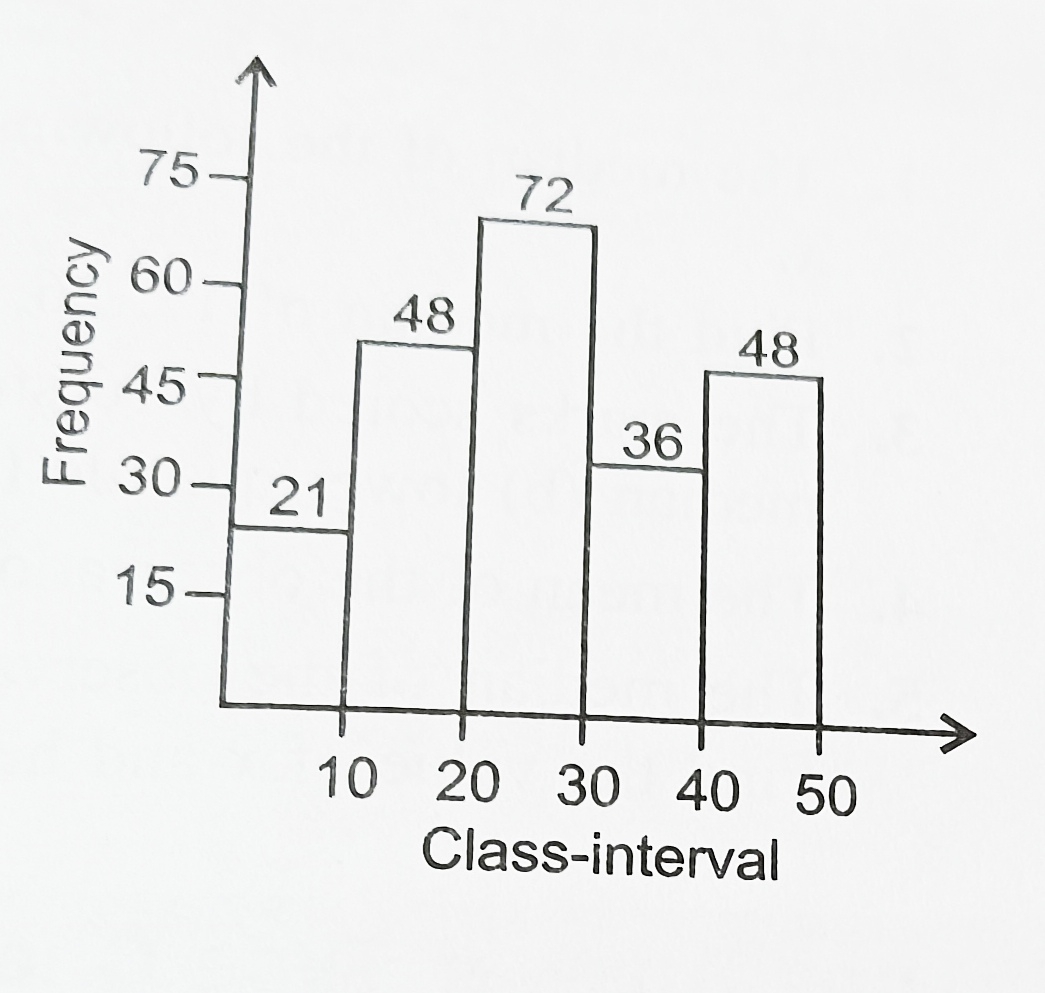
2) In the given book graph,
the modal class is the class will frequency
a)  72 b) 21 c) 48 d) 36

3) Which of the following is correct?
a) mode= 3 median - 2 mean 
b) mode= 2 median - 3 mean 
c) mode= 3 median + 2 mean 
d) mode= 2 mean - 3 median 

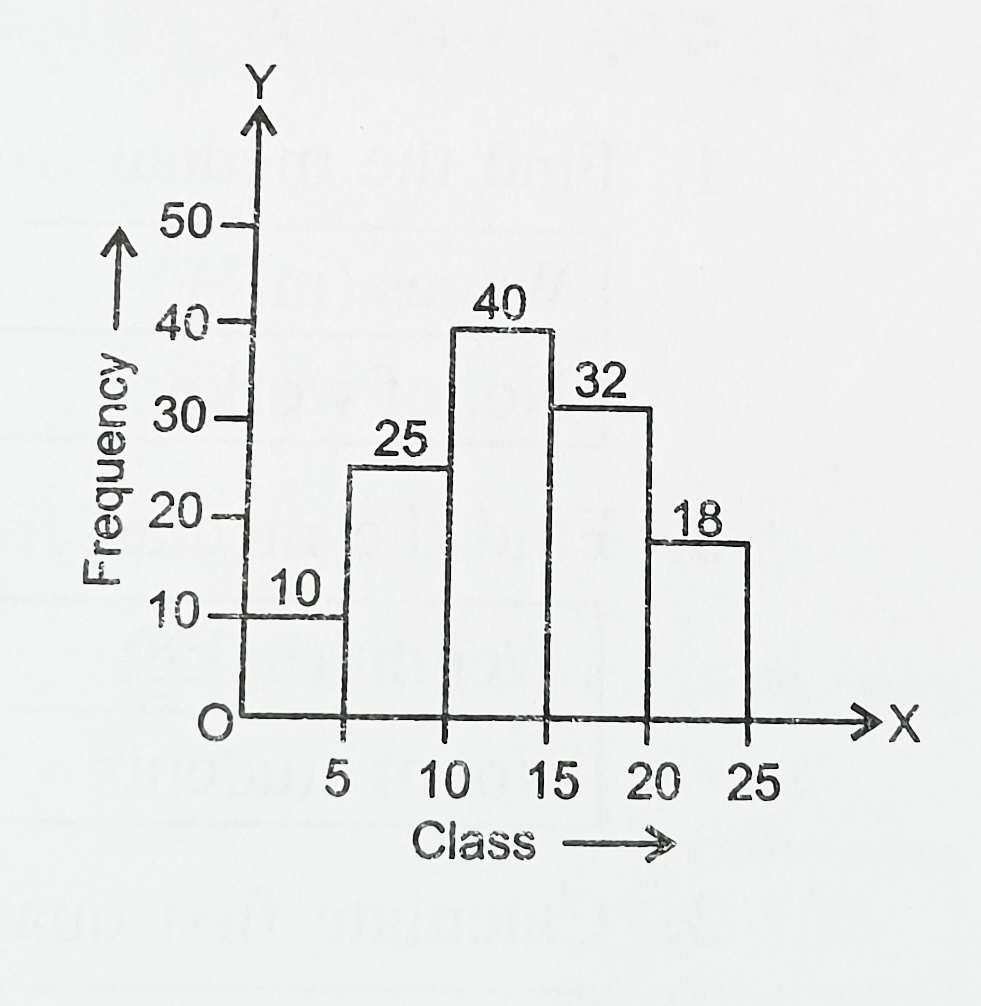
4) In the given histogram,
the upper limit of the modal class is:
a) 10 b) 15 c) 20 d) 25

5) The class mark of the median class of the given distribution is 
Class    Cumulative frequency 
00-10       8
10-20      10
20-30      17
30-40      26
40-50      30
a) 15 b) 25 c) 30 d) 35

6) Semi-inter quartile range is given by 
a) (Q₃ + Q₁)/2
b) (Q₃ - Q₁)/2
c) (Q₃ + Q₁)
d) (Q₃ + Q₁)/3

7) The median of the data 8,5,-2,4,0,7,10,6,3 is
a) 0 b) 5 c) -2 d) 10

8) The mode of the given observation 10,22,15,18,17,15,10,21,9,6,10,16,15,4,15 is
a) 15 b) 10 c) 22 d) 6

9) From the data 37,35,30,34, 40,39,38,36 if 35 is removed, the median increases by:
a) 0.5 b) 1 c) 2 d) 35

10) The median of the data 78,56,22,34,45,54,39,68,54,84 is
a) 53 b) 54 c) 55 d) 56

11) In a grouped frequency distribution, the class with maximum frequency is called 
a) mean class b) media class c) modal class d) quartile class

12) Quartile divide the whole set of observation into ____ equal parts.
a) two b) three c) four d) ten

13) The middle Quartile is also known as 
a) median b) mode c) mean d) class mark 

14) The difference between upper quartile (Q₃) and lower quartile ( Q₁) is called 
a) range 
b) semi inter quartile range 
c) interquartile range d) limits

15) If the median of the data 24,25,26, x+2, x +3, 30,31,34 arranged in order is 27.5, then the value of x is 
a) 25 b) 27 c) 28 d) 30


1c 2a 3a 4b 5d 6b 7b 8a 9a 10b 11c 12c 13a 14c 15a 


Short Answer Type Questions 


1) The median of the following obser11,12,14,18, (x +4), 30, 32,35,41 arranged in ascending order is 24. Find x.

2) Find the median of 17,26,60,45,33,32,29,34,56. If 26 is replaced by 62, find the new median.

3) The marks scored by 16 students in a class test are: 3,6,8,13,15,5 , 21,23,17,10, 9, 1,20,21, 18,12. Find 
a) the median 
b) lower quartile 
c) upper quartile 

4) The mean of the observations 23, (x -5),36, (x -9), (x -1) and 28 is 21. Find the value of x and hence find the median.

5) The median of the observation 11,12,14, (x -2), (x +4), (x +9),32,38 and 47 arranged in ascending order is 24. Find the value of x and hence find the mean,


1) 20 2) 33;34 3) 12.5,6,18 4) 18,20 5) 20,25


Long Answer Type Questions 


1) Find the median from the following frequency distribution:
Wages.   No of workers 
280          12
320          16
360          20
440          17
480          13
550          11

2) Find the median from the following frequency distribution:
Weight   no of students 
56           6
59           8
62          13
64          12
66           9
70           6

3) Calculate first quartile, third quartile and quartile range from the following data:
Weight: 4  5  6  8  11  13   14
F:           2  4  5  7   3     2     1 

4) In a class of 40 students, marks obtained by the students in a class test(out of 10) are given below:
Marks    no of students 
1             1
2             2
3             3
4             3
5             6
6            10
7             5
8             4
9             3
10           3
Calculate the following for the given distribution:
a) median 
b) mode

5) The distribution given below shows the marks obtained by 25 students in an aptitude test. Find the median and mode of the distribution.
Marks: 5  6  7  8  9  10 
F:          3  9  6  4  2  1

6) A mathematical aptitude test of 50 students was recorded as follows:
Marks   no of students 
50-60      4
60-70      8
70-80     14
80-90     19
90-100   5
Draw a histogram for the above data using a graph paper and locate the mode.

7) Draw a histogram for the following frequency distribution and find mode from the graph.
Class    frequency 
00-05       2
05-10       5
10-15      18
15-20      14
20-25       8
25-30       5

8) (Use a graph paper for this question.) The daily pocket expenses of 200 students in a school are given below:
Expenses.    Frequency 
00-05             10
05-10             14
10-15             28
15-20             42
20-25             50
25-30             30
30-35             14
35-40             12
Draw a histogram representing the above distribution and estimate the mode from the graph.

1) Rs360 2) 63kg 3) 5,8,3 lbs
4) 6,6
5) 7,6
6) 82.5 7) 14 8) 21

Long Answer Type Questions - II 

1) The table shows the distribution of the scores obtained by 160 shooters in a shooting competition. Use a graph sheet and draw an ogive for the distribution. (take 2cm= 10 score on the x-axis and 2cm = 20 shooters on the y-axis).
Scores  no of shooters
00-10       9
10-20       13
20-30       20
30-40       26
40-50       30
50-60       22
60-70       15
70-80       10
80-90         8
90-100       7
Use your graph to estimate the following:
a)  the medium 
b) the interquartile range 
c) The number of shooters who obtained a score of more than 85%.

2) The daily wages of 80 workers in a project are given below:
Wages    No of workers 
400-450        2
450-500        6
500-550       12
550-600       18
600-650       24
650-700       13
700-750         5
Use a graph paper to draw an ogive for the above distribution. (Use a scale of 2cm = Rs50 on x-axis and 2cm = 10 workers on y-axis). Use your ogive to estimate:
a) the median wage of the workers.
b) the lower quartile wage of workers.
c) the number of workers who earn more than Rs625 daily.

3) Use graph paper for this question.
A survey regarding height (in cm) of 60 boys belonging to class 10 of a school was conducted. The following data was recorded:
Height    no of boys 
135-140     4
140-145     8
145-150     20
150-155     14
155-160      7
160-165      6
165-170      1
Taking 2cm = height of 10cm along one axis and 2cm= 10 boys along the other axis, draw an ogive for the above distribution. Use the graph to estimate the following:
a) the median 
b) lower quartile 
c) if above 158cm is considered as the tall boys of the class, find the number of boys in the class who are tall.

4) 40 students enter for a game of shot-put competition. The distance thrown (in metres) is recorded below:
Distance  no of students 
12-13         3
13-14         9
14-15       12
15-16         9
16-17         4
17-18         2
18-19         1
Use a graph paper to draw an ogive for the above distribution.
Use a scale of 2cm= 1m on one axis and 2cm = 5 students on the other axis.
Hence using your graph find 
a) the median 
b) upper quartile 
c) the number of students who cover a distance which is above 33/2 m.

1) 44    31   11
2) Rs600, Rs 550, 29
3) 149cm, 146, 9
4) 14.6m, 15.6m, 5


BANKING 

1) Sujata has a recurring deposit account in a bank for 2 years at 6% p.a, simple interest. If she gets Rs1200 as interest at the time of maturity, then her monthly installment is :
a) Rs500 b) Rs600 c) Rs700 d) Rs800
 
2) A man deposited Rs1000 per month in a recurring deposit account for 3 years at 8% p.a, The maturity value is:
a) Rs440000 b) Rs 40000 c) Rs40440  d) Rs44444

3) Abhinav deposited Rs200 per month for 3 years in a bank's recurring deposit account. If the bank pays intrest at the rate of 11% p.a., then the interest at the time of maturity is:
a) Rs1210 b) Rs1221 c) Rs1415 d) Rs1521

4) Kamal has a recurring deposit account in a bank for 2 years at 6% p.a., S. I. if he gets Rs1350 as interest, then the monthly installment is:
a) Rs1000 b) Rs900 c) Rs850 d) Rs

5) if Kavita deposited Rs900 per month for 2 years and 6 months in a recurring deposit account, then the total money she deposited in the account is:
a) Rs 26000 b) Rs27000 c) Rs28000 d) Rs30000 

6) A man deposited RsX per month for Y years in a recurring deposit account. If at the time a maturity he got RsZ as interest, then the total maturity amount is:
a) Rs(12XY + Z) b) Rs 12 X Y Z c) Rs( X Y + 12Z) d) Rs  XYZ/12

7) Karan deposited Rs2000 per month for 3 years in a recurring deposit account . if the rate of interest is 11% p.a., the amount he gets on maturity is:
a) Rs72000 b) Rs80000 c) Rs82210 d) Rs 84210

8) A man deposited Rs2000 per month in a recurring deposit account for 18 months at 8% p.a, The interest he will get at the time of maturity is :
a) Rs2280  b) Rs2350 c) Rs2400 d) Rs2410 

9) Mr Awasthi has a 4 year time deposit account and deposits Rs 650 per month. If he received Rs5096, as interest at the time of maturity, the rate of interest is:
a) 8% p.a b) 8.5%p.a c)  9%p.a d)  10%p.a

10) Sharda deposited Rs150 per month in a bank for 8 months under the recurring deposit scheme. If the rate of interest is 8% p.a., then intrest earned at the time of maturity is:
a) Rs50 b) Rs40 c) Rs36 d) Rs30

11) Ravi has a 4 year cumulative time deposit account and deposits Rs650 per month. If he receives Rs36296 at the time of maturity , the rate of interest was :
a) 10% p.a b) 9%p.a c)  8%p.a d)  7.5%p.a

12) Piyush has a recurring deposit account for 2 years at 10%p.a. If he receives Rs1900 as intrest , the monthly installment paid by him is:
a) Rs700 b) Rs750 c) Rs760 d) Rs800

13) A man deposited Rs1500 every month in a bank for 8 months under the recurring deposit scheme. If the rate of interest is 8%p.a, than the interest earned at the time of maturity is:
a)Rs 400 b) Rs350 c) Rs36⁰ d) Rs320 

14) Kamal deposits Rs4000 per month in a recurring deposit account for 3/2 years at 6%p.a. The intrest he will receive at the time of maturity is:
a)Rs 3420 b) Rs3240 c) Rs3150 d) Rs3110

15) Garima deposited Rs500 per month in a recurring deposit account for 3 years. If the rate of interest is 4%p.a, then the amount she gets at the time in maturity is:
a) Rs1110 b) Rs19110 c) Rs 20150 d) Rs21110

16) Amrita deposited Rs1600 per months in a recurring deposit account for 2 years. If the rate of interest is 8% p.a, then the interest earned by her at the time of maturity is:
a) Rs 3200 b) Rs3450 c) Rs3550  d) Rs3600

17) Manisha deposited Rs500 per month recurring deposit account for 2 years. If the bank pays interest at 8%p.a, then the interest she gets at the time of maturity is:
a) Rs 1000 b) Rs1100 c) Rs 1200  d) Rs1500 

18) Ajay deposited Rs2400 per month for 18 months in a bank's recurring deposit account. If the bank pays interest at 6%p.a, the interest he gates at the time of maturity is:
a) Rs 1550  b) Rs18000 c) Rs2052 d) Rs3250

19) Sameer has a recurring deposit account in the bank for 3 years at 4% simple interest. If he gets Rs4440 as interest at the time of maturity, then the monthly installment is:
a) Rs2000 b) Rs26000 c) Rs3000 d) Rs3200

20) Dinesh has a recurring deposit account, which pays interest at 5%p.a. if he pays Rs 2500 per month for 2 years, then the interest he will get at the time and maturity is
a) Rs 3000 b) Rs3025  c) 3200 d) Rs3125 

1d 2c 3b 4b 5b 6a 7d 8a 9a 10c 11c 12c 13c 14a 15b 16a 17a 18c 19a 20d 


Short Answer Type Questions:

1) Rekha opened a recurring deposit account for 20 months. The rate of interest is 9% per annum and Rekha receives Rs441 as interest at the time of maturity. Find the amount Rekha deposited each month.

2)  Mr Sonu has a recurring deposit account and deposited Rs750 per month for 2 years. If he gets Rs19125 at the time of maturity, find the rate of interest.

3) Kabeer opened a recurring deposit account in a bank and deposited Rs300 per month for 2 years. If he received Rs7725 at the time of maturity, find the rate of interest per annum.

4) Ram deposits Rs1000 per month in a recurring deposit account for 3 years at 8% per annum intrest. Find the maturity value.

5) Reema deposited Rs200 per month for 3 years in a bank' recurring deposit account. If the bank pays interest at the rate of 11% p.a., find the amount she gets on maturity.

6) Harishankar opened a recurring deposit account in a bank and deposited Rs800 per month for 18 month. If he received Rs15084 at the time of maturity, find the rate of interest per annum.

Answers 
1) Rs280 2) 6% 3) 7% 4) Rs40440 5) Rs8421 6) 6%


Long Answer Type Questions 

1) Mohan has a recurring account in a bank for 2 years at 6% simple interest. If he gets Rs1200 as intrest at the time of maturity, find 
a) the monthly installment.
b) the amount of maturity.

2) Priyanka has a recurring deposit account of Rs1000 per month at 10% per month. If she gets Rs5550 as interest at the time of maturity, find the total for which the account was held.

3) Manish opened a recurring deposit account in a bank. He deposited per month for two years. At the time of maturity, he got Rs67500. Find 
a) the total interest earned by Manish.
b) the rate of interest per annum.

4) Mr Gupta has a recurring deposit account in a bank. He deposits Rs2500 per month for 2 years. If he gets Rs66250 at the time of maturity, find
a) the interest paid by the bank.
b) the rate of interest.

5) Mr Garg deposits a certain sum of money each month in a recurring deposit account of a bank. If the rate of interest is 8% p.a and Mrs Garg gets Rs 8088 from the bank after 36 months, find the value of his monthly installment.

5) Vandana has recurring time deposit account of Rs340 per month at 6% p.a. If she gets Rs7157 at the time of maturity, find the total time for which the account was held.

Answers:
1) Rs8000, Rs20400 2) 3 years 3) Rs7500, 12% 4) Rs6250, 10% 5) Rs200 6) 20 months 


TRIGONOMETRIC IDENTITIES 

1) {(1+ tanθ)/(1+ tanθ)}² = 
a) 1 b) tan²θ c) tanθ d) 4

2) (sinA - 2 sin³A)/(2cos³A - cosA) is equal to 
a) secA b) tanA c) cotA d) 1

3) If tanx = cotx, then
a) x - = 90 b) x= y = 90 c) x + y= 90 d) y - x =90

4) (sec²θ -1)(1- cosec²θ) is equal to 
a) -1 b) cotθ c) 0 d) cosecθ

5) √{(secθ -1)/(secθ +1)} + √{(secθ +1)/(secθ -1)} is equal to 
a) 2cosecθ  b) 2secθ c) 2tanθ  d) 2sinθ 

6) If sinθ + cosθ = a and secθ + cocosθ =b, then the value of b(a²-1) is 
a) 2a b) a+ b c) 2b d) a - b

7) If sinθ + cosθ = √2cosθ, then the value of cosθ - sinθ is 
a) √cosθ  b) sinθ  c) √sinθ  d) cosθ 

8) cosec²θ/(1 + cot²θ) =
a) 0 b) cosec θ c) 1 d) cotθ 

9) sinθ + 2cosθ = 1, then the value of 2sinθ - cosθ =
a) 1 b) 2 c) √2 d) 0

10) If (sinθ + cosθ)(tanθ + cotθ) = 
a) secθ + tanθ  b) secθ  c) secθ + coseθ  d) cosecθ 

11) sinθ/(1+ cosθ)  + (1+ cosθ)/sinθ =
a) 2sinθ  b)  2cosθ c) 2tanθ d) 2cosecθ 

12) cosθ/(1- sinθ)  + cosθ/(1+ sinθ) =
a) 2sinθ b)  2cosθ c) 2 cosecθ  d) 2secθ 

13) 5 tan²θ - 5 se²θ =
a) 5 b) -5 c) 1/5 d) 0

14) If secθ + tanθ =p, then (p²-1)/(p²+1)=
a) tanθ b) cosθ c) sinθ  d) cocosθ 

15) sin⁶θ + cos⁶θ + 3sin²θ. cos²θ =
a) 0 b) 1 c) 2 d) -2

16) If sinθ + cosθ = √3, then tanθ + cotθ =
a) 1 b) -1 c) 2 d) -2

17) secθ(1-  sinθ)(secθ + tanθ) =
a) 0 b) 1/2 c) 1 d) none 

18) 9 sec²θ - 9 tan²θ =
a) 1 b) 9 c) 8 d) 0

19) (1+ tanθ + secθ)(1+ cotθ - cosecθ =
a) 0 b) 1 c) 2 d) -1

20) (1+ tan²θ)/(1+ + cot²θ) =
a) sec²θ  b) -1 c)  cot²θ  d) tan²θ 

21) (secθ + tanθ)(1-  sinθ =
a) secθ  b) sinθ  c) cocosθ d) cosθ 

22) 2 cos²θ + 2/(1+ cot²θ) =
a) 1 b) 2 c) 0 d) 1/2

23) Simplified form of (3- tanθ)/(3cosecθ - secθ) is 
a) cosθ  b) sinθ  c) cocosθ  d) tanθ 


1b 2b 3c 4a 5a 6a 7c 8c 9b 10c 11d 12d 13b 14c 15b 16a 17c 18b 19c 20d 21d 22b 23b 


SHORT ANSWER TYPE QUESTIONS 

Prove the following:
1) secθ/(secθ -1) +  secθ/(secθ + 1) = 2cosec²θ.

2) √(sec²θ + cosec²θ) = tanθ + cotθ 

3) (cosecθ - sinθ)(secθ - cosθ)(tanθ + cotθ) = 1

4) sinθ/(1+ + cotθ) - cosθ/(1+ tanθ) = sinθ - cosθ

5) sin⁴θ - cos⁴θ = 1- 2cos²θ 

6) (1- sinθ)/(1+ sinθ) = (secθ - tanθ)² 

7) (sin²x cos²y - cos²x sin²y) = sin²x sin²y.

8) Simplify: (sec²θ - 2 tan²θ)(1- sinθ)(1+ sinθ).

9) For what value of x, 2sin²x - cos²x = 2 ?

10) Find the value: tan²x + cot²x - sec²x cosec²x.

11) sinθ/(cotθ + cosecθ) - sinθ/(cotθ - cosecθ).


8) 1- 2 sin²θ  9) 90° 10) -2 11) 2


LONG ANSWER TYPE QUESTIONS 

1) If tanθ + sinθ =m and tanθ - sinθ =n, show that m²- n²= 4 √(mn).

2) Show that: (secθ + tanθ -1)/(tanθ - secθ +1) =(1+ sinθ)/cosθ.

3) If tanθ + secθ = m, then find the value of (m²+1)/2m.

4) Express, a cosθ - b sinθ in terms of a, b and c, where a sinθ + b cosθ = c.

5) Show that: tanθ/(1- cotθ) + cotθ/(1 - tanθ) = tanθ + cotθ+ 1.

6) Show that: (secθ + tanθ -1)(secθ - tanθ +1)/tanθ  = 2.

7) If x= a secθ + b tanθ and y= a tanθ + b secθ, then evaluate (a²- b²)/(x²- y²).

8) If x= a secm cos n, y= b secm sin n and z= c tan m, then evaluate x²/a² + y²/b² - z²/c².

9) Show that: 1/(secθ - tanθ) - 1/cosθ - 1/(secθ + tanθ).

10) Show that (1+ cotθ - cosecθ)(1+ tanθ + secθ) = 2.


3) secθ  4) ± √(a²+ b² - c²)


BOOSTER - B
1) Solve the following equations by factorisation:
a) x² + 6x + 5=0. -5,-1
b) 8x² -22x -21 =0. 7/2,-3/4
c) 9x² - 3x -2 =0. 2/3,-1/3

2) Solve the following equations by factorisation method:
a) x² + 2√2x -6 =0. -3√2, √2
b) √3 x² + 10x + 7√3 =0. -√3, -7/√3

3) Solve the following equation by factorisation method:
a) x² - 9=0. ±3
b) x² - 8x + 16=0. 4,4

4) Solve the following equation by factorisation method:
a) x/(x +1) + (x +1)/x = 34/15, x≠0, x≠ -1. 3/2,-5/2
b) (x+3)/(x -2) - (1- x)/x = 17/4, 4,-2/9
c) 1/(x -2) + 2/(x -1) = 6/x. 3, 4/3

5) Solve the following equation by factorisation method:
a) 4/x - 3 = 5/(2x +3). -2, 1
b) 2x/(x -3) + 1/(2x +3) + (3x +9)/{(x -3)(2x +3) = 0. -1

6) x= 1/2- 1/2 - 1/(2- x), x ≠ 2. 1,1

7) Solve the following equation by factorisation method:
a) x²- 2ax + a²- b²= 0. a- b, a+ b
b) x²- 4ax + 4a²- b²= 0. 2a- b, 2a+ b
c) 4x²- 4ax + (a²- b²)= 0. (a+ b)/2, (a - b)/2
d) 4x²- 4a⅖x + (a⁴- b⁴) = 0. (a¹+ b²)/2, (a²- b²)/2

8) Solve the following equation by factorisation method:
a) 4x²- 2(a²+ b²)x + a²b²= 0. a²/2, b²/2
b) 9x²- 9(a+ b)x + (2a²+ 5ab + 2b²) = 0. (2a+ b)/3, (a+ 2b)/3

9) Solve the following equation by factorisation method 
a) x²+ {a/(a+ b) + (a+ b)/a }x + 1= 0. -a/(a+ b), -(a+ b)/a
b) x² + x - (a+1)(a+ 2) = 0. -(a+2), a+1
c) x² + 2x - (a²+ a -2) = 0. -(a +2), a -1

10) Solve the following equation by factorisation method:
a) 1/(a+ b + x) = 1/a + 1/b + 1/x, a+ b ≠0. -a, - b

11) Solve:
a) x + 1/x = 25+ 1/25. 25, 1/25
b) (x -3)+x -4)= 34/33². 98/33, 133/33

BOOSTER - C
1) Write the discriminant of the following equations
a) x²- 4x +2=0.         8
b) 3x² + 2x - 1=0.         16
c) x²- 4x + a=0.           16- 4a
d) √3 x²- 2√2x - 2√3=0.        32
e) x² + x + 1 =0.        -3
f) x² + px +2q =0.       p¹- 8q

2) Determine the nature of the roots of the following equations:
a) 2x² + x -1 =0.       Real, distinct 
b) x²- 4x + 4=0.        Real, equal 
c) x² + x + 1=0.       Not real 
d) 4x²- 4x + 1 =0.     Real, equal 
e) 2x²+ 5x +5 =0.     Not real 

3) In the following, determine whether the given Equation have real roots and if so, find the roots.
a) 9x²+ 7x -2=0.      Y, 2/9,-1
b) 2x²+ 5√3x +6 =0.      Y, -√3/2,-2√3
c) 3x²+ 2√5x - 5=0.       Y, √5/3,-√5
d) x²+ 5x + 5=0.            Y, (-5±√5)/2
e) 6x²+ x -2 =0.              Y, 1/2,-2/3
f) 25x²+ 20x +7 =0.       N

4) Using Quadratic formula solve the following equation:
a) p²x²+ (p²- q²)x - q² =0.        q²/p²,-1
b) 9x² - 9(a+ b)x + (2a²+ 5ab + 2b²) =0.      (2a+ b)/3,(a+ 2b)/3

BOOSTER - D

1) Find the values of k for which the given Equation has real and equal roots:
a) 2x² - 10x + k =0.     25/2
b) 9x²+ 3kx + 4 =0.     ±4
c) 12x²+ 4kx +3 =0.    ±3
d) 2x²+ 7p3x + k =0.    9/8
e) 2x² - kx + 1=0.         ±2√2
f) kx² - 5x + k =0.        ±5/2
g) x²+ k(4x+ k -1) +2 =0.      2/3,-1
h) x² - 2x(1+ 3k)+ 7(3 +2k) =0.    2, -10/9
i) (k+1)x² - 2(k  -1)x +1 =0.       0,3

2) Find the values of k for which the following equation has equal roots:
(k -12)x²+ 2(k -12)x +2=0.        12,14

3) If -4 is a root of the equation x²+ px - 4 =0 and the Quadratic equation x²+ px + k =0 has equal roots, find the value of k.      9/4

4) Find the values of k for which the equation x²- 4x + k =0 has distinct real roots.    <4

5) Show that the equation x²+ ax - 4 =0 has real and distinct roots for all real values of a.        

6) If p,q,r are real and p≠ q, then show that the roots of the quadratic equation (p - q)x²+ 5(p + q)x -2(p - q)=0 are real and unequal.

7) Determine the positive of k for which the equation x²+ kx + 64=0 and x² - 8x + k =0 will both have real roots.      16

8) Find the values of k for which the given Equation has real roots.
a) kx² - 6x -2=0.      ≥ -9/2
b) 9x²+ 3kx + 4=0.      ≤-4, ≥4
c) 5x² - kx + 1 =0.       ≤-√20 or ≥ √20

9) Find the values of k for which the equation x²+ 5kx  + 16 =0 has no real roots.   -8/5< k < 8/5

10) If p,q,r and s are real numbers such that pr = 2(q+ s), then show that atleast one of the equation x²+ px + q=0 and x²+ rx + s =0 has real roots.

11) If the roots of the equation x²+ 2cx  + ab =0 are real and unequal, show that the equation x² - 2(a + b)x + a²+ b²+ 2c²=0 has no real roots.

12) Show that the equation x²(a²+ b²)+ 2x(ac + bd) + (c²+ d²) =0 has no real root, if ad ≠ bc.

13) Find the value of k for which the given Equation has equal roots. Also, find the roots.
a) 9x² - 24x + k =0.      4/3
b) 2kx² - 40x +25 =0.     5/4

14) Find the value of k for which the equation (k +4)x²+ (k +1)x + 1 =0 has equal roots.    5,-3

15) If -5 is a root of the equation 2x²+ px - 15 =0 and the equation p(x²+ x)+ k =0 has equal roots, find the value of k.       7/4

16) Using quadratic formula, solve the following equation for x: abx²+ (b²- ac)x - bc =0.   c/b, -b/a

17) Solve for x: (x -1)/(x +2) + (x -3)/(x - 4) = 10/3, x ≠ -2,4.       (1±√297)/4

18) Solve for x: 1/(x -1) + 2/(x +2)=4/ (x +4), x≠ -1, -2, -4.        2±2√3


MEAN 

BOOSTER - A

1) If the mean of 6,4,7, p and 10 is 8, find the value of p.       13

2) Find the sum of the deviation of the variate values 3,4,6,8,14 from the mean.      0

3) The mean of 40 observations was 160. It was detected on rechecking that the value of 165 was wrongly copied as 125 for computation of mean. Find the correct mean.  161

4) The mean of 100 items was found to be 30. If at the time of the calculation two items were wrongly taken as 32 and 12 instead of 23 and 11, find the correct mean.   29.9

5) The mean monthly salary of 10 members of a group is Rs1445, one more member whose monthly salary is Rs 1500 has joined the group. Find the mean monthly salary of 11 members of the group.      Rs1450

6) the mean of 10 numbers is 20. If 5 is substracted from every number, what will be the new mean ?      15

7) The mean of 16 numbers is 8. if 2 is added to every number, what will be the new mean ?        10.

8) The mean of 5 numbers is 18. If one number is excluded, their mean is 16. Find excluded number.      26

9) If the mean of 5 observations x, x+2, x+4, x+6, x+8, is 11, find the mean of first three observations.        9.

10) The mean of 25 observation is 36. if the mean of first 13 observations is 32 and the mean of last 13 observatiorn is 39, find the 13th observation.    23

11) Find the mean of first n natural numbers.       (n+1)/2

12) find the mean of 0, 2, 4, 6, 8,....2n.     n

13) Find the mean of the first n odd natural numbers.     n

14) if the mean of 1, 2, 3,....n is 6n/11, find the value of n.      11

15) The mean of a set of observation is K. If each observation is divided by p, p≠ 0 and then increased by 10, then show that the mean of the new set of observations is K/p  + 10.
BOOSTER - B

1) Find the mean of the following distribution:
x: 4    6      9   10   15
f: 5   10    10   7     8             9 

2) Following table shows the weights of 12 students:
Weight (in kgs): 67     70     72     73    75
No of students:  4        3       2       2      1 
Find the mean weight.                70.25kg

3) Find the mean of the following distribution:
X: 10    30    50     70    89
F:  7      8     10     15     10.          55

4) If the mean of the following distribution is 6, find the value of p.
X: 2    4    6    10    p+5
F: 3    2    3     1       2            7

5) Find the value of p, if the mean of the following distribution is 7.5.
X: 3    5    7    9    11   13
F: 6    8   15    p    8     4          3

6) Find the missing frequencies in the following frequency distribution if it is known that the mean of the distribution is 1.46.
No of accidents(x): 0  1  2   3    4   5  total 
Frequency (f):         46 ?  ?  25  10  5  200       76,38


BOOSTER - C
1) The following table shows the weight of 12 students:
Weight (in kg):  67   70   72   73   75 
No of students:  4     3     2     2      1 
Find the mean weight.          70.25 kg

2) Find the mean wage from the data given below:
Wages: 800 820 860 900 920 980 1000
F:            7     14   19    25  20    10     5      891.2

3) Apply step-deviation method to find the AM of the distribution:
Variate (x)   Frequency(f)
5                     20
10                   43
15                   75
20                   67
25                   72
30                   45
35                   39
40                    9
45                    8
50                    6       22.214

3) The weight in kilograms of 60 workers in a factory are given in the following frequency table. Find the mean weight of a worker.
Weight (in kg): 60. 61  62  63. 64  65
No of workers: 5    8    14  16  10   7         62.65

4) The table given the distribution of villages under different heights from sea level in a certain region. Compute the mean height of the region:
Height: 200 600 1000 1400 1800 2200
F:          142 265  560    271    89     16      984.51

BOOSTER - D
1) Find the mean of the following frequency distribution:
Class interval      frequency 
00-10                     7
10-20                    10
20-30                    15
30-40                     8
40-50                    10       25.8

2) The following table gives the distribution of total household expenditure (in rupees) of manual workers in a city.
Expenditure (in Rs)   frequency 
100-150                      24
150-200                      40
200-250                      33
250-300                      28
300-350                      30
350-400                      22
400-450                      16
450-500                       7   266.25

3) A frequency distribution of the life times of 400 TV picture tubes tested in a tube company is given below. Find the average life of tube.
Life time(in hrs)   no of tubes
300-399                14
400-499                46
500-599                58
600-699                76
700-799                68
800-899                62
900-999                48
1000-1099            22
1100-1199             6.        715hrs

4) The following table gives weekly wages in rupees of workers in a certain commercial organisation. The frequency of class 49-52 is missing. It is known that the mean of the frequency distribution is 47.2. find the missing frequency.
Weekly wages (Rs)  no of workers 
40-43                          31
43-46                          58
46-49                          60
49-52                           ?
52-55                         27         44

5) The mean of the following frequency table is 50. But the frequencies a, and b in class 20-40 and 60-80 are missing. Find the missing frequencies.
Class      frequency 
00-20       17
20-40        a
40-60       32
60-80        b
80-100     19
     Total.  120         28,24

6) Find the mean marks of students from the following cumulative frequency distribution:
Marks.             No of students 
0 and above     80
10 and above   77
20 and above   72
30 and above   65
40 and above   55
50 and above   43
60 and above   28
70 and above   16
80 and above   10
90 and above    8
100 and above  0        51.75

7) Find the mean marks of the students from the following cumulative frequency distribution:
Marks        No of students 
Below 10     5
Below 20     9
Below 30    17
Below 40    29
Below 50    45
Below 60    60
Below 70    70
Below 80    78
Below 90    83
Below 100  85       48.41  


HEIGHT AND DISTANCE (1)

1) A tower stands vertically on the ground. From a point on the ground, 20 away from the foot of the tower, the angle of the elevation of the top of the tower is 60°. What is the height of the tower ?     20√3

2) The angle of elevation of a ladder leaning against a wall is 60° and the foot of the ladder is 9.5 m away from the wall. Find the length of the ladder.     19m

3) A ladder is placed along a wall of a house such that it's upper end is touching the top of the wall. The foot of the ladder is 2m away from the wall and the ladder is making an angle of 60° with the level of ground. Determine the height of the wall.      2√3m

4) An electric pole is 10m high. A steel wire tied to top of the pole is affixed at a point to the ground to keep the pole up right. if the wire makes an angle of 45° with the horizontal through the foot of the pole, find the length of the wire.     14.1m

5)  A kite is flying at a height of 75 m from the ground level, attached to a string inclined at 60° to the horizontal. Find the length of the string to the nearest metre.   87m

7) A vertical tower stands on a horizontal plane and is surmounted by a vertical flagstaff . At a point on the plane 70m away from the tower, an observer notices that the angles of elevation of the top and the bottom of the flagstaff are respectively 60° and 45°. Find the height of the flagstaff and that of the tower.     51.24m, 70m

8) A vertically straight tree, 15m high , is broken by the wind in such a way that its top just touches the ground and make an angle of 60° with the ground. At what height from the ground did the tree break ?        6.9m

9) A vertical tower stands on a horizontal plane and is surmounted by a vertical flagstaff of height 5 m. At a point on the plane, the angles of elevation of the bottom and the top of the flagstaff are respectively 30° and 60°. Find the height of the tower.     2.5 m

10) A person observed the angle of elevation of the top of the tower as 30°. He walked 50m towards the foot of the tower along level ground and found the angle of elevation of the top of the tower as 60°. Find the height of the tower.        43.24 m

11) The shadow of the tower when the angle of elevation of the sun is 45° is found to be 10m longer than when it was 60°. Find the height of the tower.      23.66 m

12) A parachute is descending vertically and makes angles of the elevation 45° and 60° at two observing points to 100m apart from each other on the left side of himself. Find the minimum height from which he falls and the distance of the point where he falls on the ground from the just observation point.         236.6m, 136.6m

13) On the same side of a tower, two objects are located. When observed from the top of the tower, their angles of depression are 45° and 60°. If the height of the tower is 150m, find the distance between the objects.        63.4m

14) The angle of elevation of a tower at a point is 45°. After going 40m towards the foot of the tower, the angle of elevation of the tower become 60°. Find the height of the tower.          94.64m

15) A vertical tower stands on a horizontal plane and is surmounted by a flagstaff of height 7m. From a point on the plane, the angle of elevation of the bottom of the flagstaff is 30° and that of the top of the flagstaff is 45°. Find the height of the tower.      9.56m

16) The length of the shadow of a tower standing on level plane is found to be 2x metres longer when the sun's attitude is 30° than when it was 45°.  Prove that the height of the tower is x(√3 +1) metres.

17) A tree breaks due to the storms and the broken part bends so that the top of the tree touches the ground making an angle of 30° with the ground. The distance from the foot of the tree.        17.3m

18) A balloon is connected to a mateorological ground station by a cable of length 215m included at 60° to the horizontal. Determine the height of the baloon from the ground. Assume that that there is no slack in the cable.         186m

19) Two men on either of the cliff 80m high observes the angle of elevation of the top of the cliff to be 30° and 60° respectively. Find the distance between the two men.       184.8m

20) Two men standing on either side of a tower 60m high observe the angles of elevation of the top of the tower to be 45° and 60° respectively. Find the distance between the two men.        94.64m

21) Find the angle of elevation of the sun (sun's altitude) when the length of the shadow of a vertical pole is equal to its height.       45°

22) A fire in a building B is reported on telephone to two fire stations P and Q, 20 km apart from each other on a straight road. P observes that the fire is at an angle of 60° to the road and Q observes that it is at an angle of 45° to the road. Which station should send its team and how much will this team have to travel ?       Station P, 14.64 km

23) A man on the deck of a ship is 10m above the water level. He observes that the angle of elevation the top of a cliff is 45° and the angle of depression of the base is 30°.  Calculate the distance of the cliff from the ship and the height of the cliff .     10√3m, 27.32m

24) A man standing on the deck of a ship, which is 8m above water level. He observes the angle of elevation of the top of a hilly as 60° and the angle of the depression of the base of the hill as 30°. Calculate the distance of the hill from the ship and the height of the hill.        8√3m, 32m

25) There are two temples, one on each bank of a river, just opposite to each other. One Temple is 50m high. From the top of this temple, The angles of depression of the top and the foot of the other temple are 30° and 60° respectively. Find the width of the river and the height of the other temple.       28.83m, 33.33m

26) The angle of the elevation of an aeroplane from a point on the ground is 45°. After a flight of 15 seconds, the elevation changes to 30°. if the aeroplane is flying at a height of 3000 m, find the speed of aeroplane.           527.04 kmph 

27) An aeroplane flying horizontally 1 km above the ground is observed at an elevation of 60°. After 10 seconds , its elevation is observed to be 30°. Find the speed of the aeroplane in kmph.           415.66 kmph 

28) From the top of a 50m high tower, the angles of the depression of the top and bottom of a pole are observed to be 45° and 60° respectively. Find the height of the pole .        21.13m

29) The horizontal distance between two trees of different heights is 60m. The angle of depression of the top of the first tree when seen from the top of the second tree is 45°. If the height of the second tree is 80m, find the height of the first tree.     20m

30) A tree standing on a horizontal plane is leaning towards east. At 2 points situated at a and b exactly due west on it, the angles of elevation of the top are respectively α and β. Prove that the height of the top from the ground is {(b - a) tanα tanβ}/(tanα -  tanβ). α β

31) The angle of elevation of the top of a vertical tower PQ from a point X on the ground is 60°. At a point 40 Y, 40m vertically above X, the angle of elevation of the top is 45°. Calculate the height of the tower.          94.64

33) If the angle of elevation of a cloud from a point h metres above a lake is α and the angle of depression of its reflection in the lake β, prove that the distance of the cloud from the point of observation is (2h secα)/(tanβ - tanα).

34) From an aeroplane vertically above a straight horizontal road, the angles of depression of two consecutive mile stones on opposite sides of the aeroplane are observed to be α and β. Show that the height in miles of aeroplane above the road is given by (tanα tanβ)/(tanα + tanβ).

35) PQ is a post of given height a, and AB is a tower at some distance; α and β are the angles of elevation of B, the top of the tower, at P and Q respectively. Find the height of the tower and its distance from the post.           a/(tanα - tanβ), (atanα)/(tanα - tanβ) 

36) A ladder rests against a wall at an angle α to the horizontal. Its foot is pulled away from the wall through a distance a, so that it slides a distance b down the wall making an angle β with the horizontal. Show that a/b = (cosα - cosβ)/(sin β - sinα).

37) A tower subtends an angle α  at a point A in the plane of its base and angle of depression of the foot of the tower at a point b metres just above A is β. Prove that the height of the tower is b tanα cotβ.

38) An observer 1.5m tall, is 28.5m away from a tower 30m high . Determine the angle of the elevation the top of the tower from his eye.      45°

39)  A carpenter makes stools for electricians with a square top of side 0.5m and at a height of 1.5 m above the ground. Also , each leg is inclined at an angle 60° to the ground. Find the length of each leg and also the length of the two steps to be put at equal distances.      1.732m, 1.1077m, 1.654 m

40) A boyis standing on the ground and flying a kite with 100m of string at an elevation of 30°. Another boy is standing on the roof of a 10m high building and is flying his kite at an elevation of 45°.  Both the boys are on opposite sides of both the kites. Find the length of the string that the second boy must have so that the two kites meet.     40√2m

41) The angle of elevation of the top of a hill at the foot of a tower is 60° and the angle of elevation of the top of the tower from the foot of the hill is 30°. If the tower is 50m high , what is the height of the hill ?      150m

42) Two boats approach a light house in mid-sea from opposite directions. The angles of elevation of the top of the lighthouse from two boats are 30° and 45° respectively. If the distance between two boats is 100m, find the height of the light house .    50(√3-1)

43) From the top of a building AB, 60m high , the angle of the depression of the top and bottom of a vertical lamp post CD are observed to be 30° and 60° respectively. Find 
a) the horizontal distance between AB and CD.       34.64m
b) the difference between the heights of the building and the lampost.      20m

44)  From the top of a lighthouse, the angles of depression of two ships on the opposite sides of it are observed to be α and β. If the height of the lighthouse be h metres and the line joining the ships passes through the foot of the light house , show that the distance between the ship is h(tanα + tanβ)/(tanα tanβ). metres

45) A straight highway leads to the foot of a tower of height 50m. From the top of the tower, the angle of depression of two cars standing on the highway are 30° and 60° respectively. What is the distance between the two cars and how far is each car from the tower ?       57.67m, 86.5m, 28.83m

46) The angles of elevation of the top of a rock from the top and foot of a 100m high tower are respectively 30° and 45°.  Find the height of the rock.      236.5m

47) As observed from the top of a 150m tall light house, the angles of depression of two ships approaching it are 30° and 45°. If one ship is directly behind the other, find the distance between two ships.          109.5m

48) A flagstaff stands on the top of a 5m high tower. From a point on the ground, the angle of elevation of the top of the flagstaff is 60° and from the same point, the angle of elevation of the top of the tower is 45°.  Find the height of the flagstaff.     3.65m

50) The angle of elevation of the top of the tower from a point A in the ground is 30°.  On moving a distance of 20 m towards the foot of the tower to a point B the angle of the elevation increases to 60°. Find the height of the tower and the distance of the tower from the point A.      17.3m, 30m

51) From the top of a building 15m high the angle of elevation of the top of a tower is found to be 30°. From the bottom of the same building, the angle of elevation of the top of the tower is found to be 60°.  Find the height of the tower and the distance between the tower and building.       22.5m, 12.975m


6) The length of a string between a kite and a point on the ground is 90m. If the string makes an angle θ with the ground level that tanθ = 15/8, how high is the kite? Assume that there is no slack in the string.        79.41 m

32) The angle of elevation of a stationery cloud from a point 2500m. Above a lake is 15° and the angle of the depression of its reflection is 45°. What is the height of the cloud above the lake level ?       2500√3

49) The angle of elevation of the top of a tower as obsorved from a point in a horizontal plane through the foot of the tower is 32°. When the observer movrs towards the tower distance and the first position from the tower. 93.64m, 46.7m